
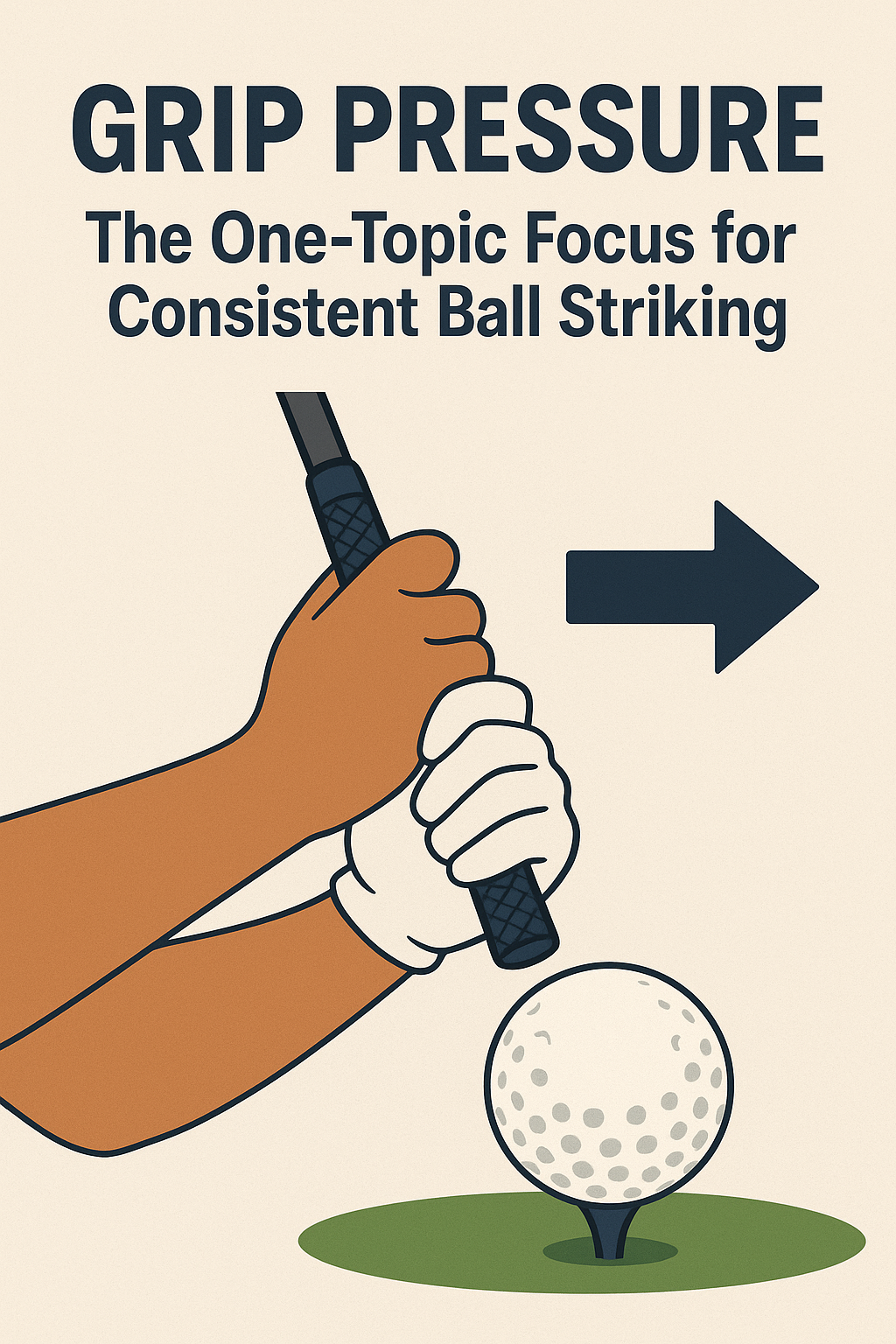
Grip Pressure: The One-Topic Focus for Consistent Ball Striking
When beginners chase perfect ball flight, they often overlook a simple, constant truth: how tightly you hold the club matters as much as how you swing. This post focuses on grip pressure—the amount of pressure you use with your hands during the swing. Mastering this single element can translate into better contact, more solid strikes, and less tension in your body.
What the concept is
- Grip pressure is the tension you feel in your hands while holding the grip. Think of it as a light to moderate squeeze rather than a death grip.
- On a practical scale, aim for about a 2–4 out of 10 in general use, with the goal of staying relaxed from setup through impact.
- It’s not about making the grip loose enough to slip. It’s about keeping the hands quiet so the wrists can hinge naturally and the clubface can stay square longer.
Why it matters to the golf swing
- Relaxed hands promote a smoother transition from backswing to downswing, helping the clubface stay on plane and reducing compensations elsewhere in the body.
- Less tension means more consistent tempo and better feel for release, which leads to cleaner contact (solid strikes and solid distance control).
- Overgripping often causes early release, scooping, or pulling the path offline. Proper grip pressure supports better sequencing and ball striking consistency.
What the golfer should feel when doing it correctly
- Quiet hands: the wrists hinge naturally without you squeezing the club.
- A light, steady feel from address to finish—no white-knuckle grip at any point.
- Balanced tension: your forearms and shoulders remain relaxed, not jangly or strained.
2–3 common mistakes (and simple fixes)
- Mistake: Gripping the club too tightly at setup and through the swing.
- Fix: Check your pressure at address. Imagine you’re holding a fragile egg. Practice 10 slow half-swings with a soft grip, then compare to 5 full swings while maintaining that softness.
- Mistake: Tension spikes during the transition from backswing to downswing, causing a jerky release.
- Fix: Do a rhythm drill: take a 1-count on the backswing and a 1-count on the downswing with a relaxed grip. If you feel your hands tighten, reset and breathe out before re-starting.
- Mistake: Inconsistent grip pressure between shots (heavy on some swings, light on others).
- Fix: Use a simple baseline: after you set up, hold the grip for a breath, then release slightly. Re-check your grip pressure before each shot or practice set to keep it steady.
One easy practice drill you can do at home or at the range
- Soft-Grip Drill: At setup, grab the club with your normal grip, then consciously reduce pressure until you can barely feel the club in your hands (as if holding a fragile egg). Hold that pressure and swing your first 5–10 practice swings slowly, focusing on maintaining the light grip through impact.
- Baseline Check: After those 5–10 swings, return to your normal grip and compare feel. If you notice you’ve returned to a tighter grip, reset to the soft-grip baseline and repeat for 5 more swings.
- Progression: On the range, swing with the soft grip for a full set, then gradually return to your normal grip over the next few swings while maintaining as much softness as possible. This helps you transfer the feeling to full-speed swings.
Keep the focus on grip pressure, not grip strength. With a relaxed, consistent hold, your clubface stays more square, your tempo smooths out, and your ball striking becomes more repeatable. Practice the Soft-Grip Drill a few minutes at a time, and you’ll notice the difference on the range and on the course.
Grip Pressure: The One-Topic Focus for Consistent Ball striking
Understanding Grip Pressure
Grip pressure refers to how firmly you hold the handle, racket, or club during the swing.It’s not about squeezing hard or letting go completely—it’s about finding a balance that preserves feel, promotes fluid motion, and allows the club to square and release naturally at impact. Too tight a grip creates excess tension in the forearms and shoulders, limiting wrist hinge and delaying clubface correction. too light a grip can lead to a loss of control and unstable contact. The goal is a “neutral grip pressure” that supports consistent ball striking across movements and over time.
Think of grip pressure as the hinge that determines how freely your hands can respond to the swing’s demands. When the hands stay relaxed, the clubface stays on plane longer, the swing arc remains steady, and impact becomes more repeatable. Conversely,gripping too hard often translates to early vertical tension,reduced leverage,and inconsistent ball flight.
Why Grip Pressure Impacts Consistency
- Enhanced clubface control: A relaxed grip allows micro-adjustments at impact, reducing shot-to-shot dispersion.
- Better tempo and rhythm: When hands aren’t fighting tension, the swing tempo stays smoother and more repeatable.
- Improved energy transfer: Moderate grip pressure helps transfer energy efficiently from body to club, increasing solid contact.
- Consistent release and view of toe/heel impact: A balanced grip supports a natural release, helping the ball start on intended lines.
- Lower injury risk and comfort: Relaxed hands translate to less compensatory tension in wrists, elbows, and shoulders, sustaining practice longer.
How to Measure Grip pressure
While you won’t find a universal scale embedded in every sport,most players benefit from thinking in simple,intuitive terms. A practical approach uses a 1–10 scale, where 1 is hands nearly at rest with minimal contact and 10 is a clenched, whites-knuckled grip. the target range for most players during a swing is usually around 2–4, with brief elevations to 5 or 6 during aggressive shots or near-impact adjustments. The key is to practice tuning the grip pressure to maintain control without inducing tension.
- Feel test: Hold the club lightly with your fingers and thumb, then perform a few practice swings. If you notice white knuckles, forearm tension, or stiffness in the shoulder, ease off.
- Feedback cues: If you sense your wrist is “locked,” your grip is likely too firm. If the club feels unstable, the grip might be too light for the situation.
- Consistency checks: After each rep, reset your grip pressure to a comfortable, relaxed level before the next swing.
Another useful cue is to pay attention to the sensation of your fingers: a light engagement through the fingers should keep the club resting on your fingers rather than gripping the palm.This promotes better finger control and reduces tension along the forearm.
Techniques to Develop Optimal Grip Pressure
Developing the right grip pressure is less about forcing a static number and more about training your body to respond with relaxed hands under pressure. The following techniques help build a repeatable feel across clubs and shots.
- Soften the initial grip: Start with a light, relaxed grip and let the club settle into your hands. Don’t squeeze in anticipation of the first move.
- Use a “soft hands” routine: Prior to each practice set, shake out the hands, take a deep breath, and reset to a comfortable pressure before addressing the ball.
- Grip pressure coupling with tempo: Align the grip pressure with your swing tempo. Slow down the transition from backswing to downswing to maintain control without increasing tension.
- Even pressure across fingers: Avoid gripping predominantly with the index finger or the palm. Engage all fingers evenly to support a stable hold that’s still light.
- Adjust by club type: Drivers often benefit from a slightly lighter grip to encourage a smoother release, while short irons may tolerate a marginally firmer hold for precision.Always return to your baseline neutral pressure.
- Breath and posture cues: During setup and at impact, exhale and release any unneeded tension through the wrists and forearms.
Drills to Train Grip Pressure
Below are practical drills that help ingrain an optimal grip pressure without sacrificing feel or control. Practice these regularly to lock in a repeatable sensation of light, responsive hands.
1) The 5-Second Hold Drill
Address the ball and hold the club with a neutral grip. Count slowly for five seconds, then ease into a light swing while maintaining the relaxed sensation. If you notice tension building,reset and repeat until you can maintain a smooth transition from hold to swing.
2) The Soft Hands Swing Drill
Perform slow-motion swings with a purposely soft grip. Focus on how the clubhead feels in your hands and feel the club return to neutral at impact. The goal is to preserve wrist hinge and a consistent release while staying relaxed.
3) The Tape Test
Place a small piece of tape on the inside of your lead-hand palm or on the grip itself. After each swing, assess how much pressure is transferred to the tape. If the tape shows excessive indentations, you’re gripping too hard and need to ease up.
4) The Finger-to-Palm Balance Drill
During practice, try to keep the grip engaged primarily by finger pressure rather than palm pressure. If you feel your palm taking over, adjust by relaxing the grip and inviting more finger contact.
Grip Pressure Across Sports
Grip pressure is a universal factor in ball striking, not limited to golf. Tennis players, baseball players, and even shooters benefit from finding a steady, comfortable hold. Across disciplines, a relaxed grip tends to yield better hand–eye coordination and smoother release. Adapting grip pressure to the nuances of each sport can unlock more consistent results, whether you’re aiming for a pure serve, a clean ground stroke, or a solid line drive.
Practical Tips and Tools
- Consistency tools: Use a grip pressure cue during practice, such as counting aloud every few seconds or visualizing a number on a clock while you swing.
- equipment checks: Ensure your grip size is appropriate for your hand size; an ill-fitting grip can cause you to compensate with greater pressure.
- Mindful practice: Alternate days with higher-intensity sessions and lighter tempo days to train your nervous system to maintain relaxed hands under varying demands.
- Video feedback: Record short practice segments to observe hand tension and grip behavior through impact, helping you spot deviations in real time.
Grip Pressure Reference
| Shot Type / Club | Target grip Pressure (1–10) | Notes |
|---|---|---|
| Warm-up/Putting grip | 2–3 | Keep it ultra-relaxed; focus on touch and touch sensitivity. |
| Short wedges (chip/approach) | 3–4 | Maintain control while allowing feel to guide the release. |
| irons (mid to long) | 3–4 | Balance control with a comfortable hold to reduce tension. |
| Driver / long game | 2–3 | Favor a lighter grip to promote a free swing and release. |
| Sign | What it feels like | Fix |
|---|---|---|
| White-knuckle grip | Ridge tension in the hands, forearms, and shoulders | Relax fingers; reset grip pressure to 2–4 and recheck after each rep |
| Inconsistent contact | Missed centers or off-center hits | Recenter grip, slow the takeaway, and emphasize light contact through impact |
| overactive wrist hinge | stiff wrists, delayed release | Soften grip; allow wrists to hinge naturally on the backswing |
Case Studies & Firsthand Experience
Case Study 1: Amateur Golfer Finds Consistency Through a Softer Grip
Emily, a 34-year-old amateur golfer, struggled with inconsistent iron shots and a tendency to over-grip during pressure-filled rounds. She started a structured grip-pressure routine, focusing on keeping her grip at a comfortable 3 on a 1–10 scale. Within six weeks, she reported a noticeable drop in shot dispersion and a higher rate of solid, center-face contact. Her practice rounds also gained momentum as she could sustain longer practice without buildup of forearm fatigue. The key turning point was treating grip pressure as a controllable, dynamic variable rather than a fixed constraint.
Case Study 2: tennis Player Reclaims Rhythm with Relaxed Hands
Alex, a club-level tennis player, found his forehand inconsistent due to gripping the racket too tightly on key rallies. By adopting a “soft hands” approach and using the 2–4 pressure target during practice, he regained wrist lag and a smoother swing path. A simple drill—soft hands swings with deep breathing—helped him maintain tension-free contact through impact, resulting in cleaner ball contact and improved control on serves and returns.
Frequently Asked Questions
- Is grip pressure the same for every club?
- Not exactly. While the general principle is to stay relaxed, different clubs may benefit from slight adjustments in pressure. Typically, drivers benefit from a lighter grip than longer irons, but always return to your baseline comfortable level.
- How do I know if I’m gripping too hard during impact?
- Common signs include excessive forearm tension, a stiff wrist, and a noticeable lack of release. If you can’t feel the clubhead through impact, ease your grip and reset.
- Can grip pressure affect swing tempo?
- Yes. Tension tends to disrupt tempo,creating jerky transitions.A relaxed grip supports a smoother, more repeatable tempo.
Key Takeaways
- Grip pressure is a controllable variable that directly influences consistency in ball striking.
- A neutral grip pressure typically sits in the 2–4 range on a 1–10 scale for most shots,with slight adaptations by club and shot type.
- Drills focusing on soft hands,tempo alignment,and feedback (tape tests,video) reinforce relaxed grip habits.
- Cross-training across sports reinforces the principle: relaxed hands unlock smoother, more reliable contact.
Closing Thoughts on Grip Pressure (Practice-oriented)
Consistency in ball striking emerges from disciplined attention to the hands’ role in the transfer of energy and control. By prioritizing grip pressure as a primary coaching focus, players across sports can unlock more repeatable contact, cleaner releases, and more confident rounds or matches. The best approach blends measurement, intentional practice, and subjective feel—always returning to the idea that relaxed hands enable a fluid, powerful, and accurate swing.