
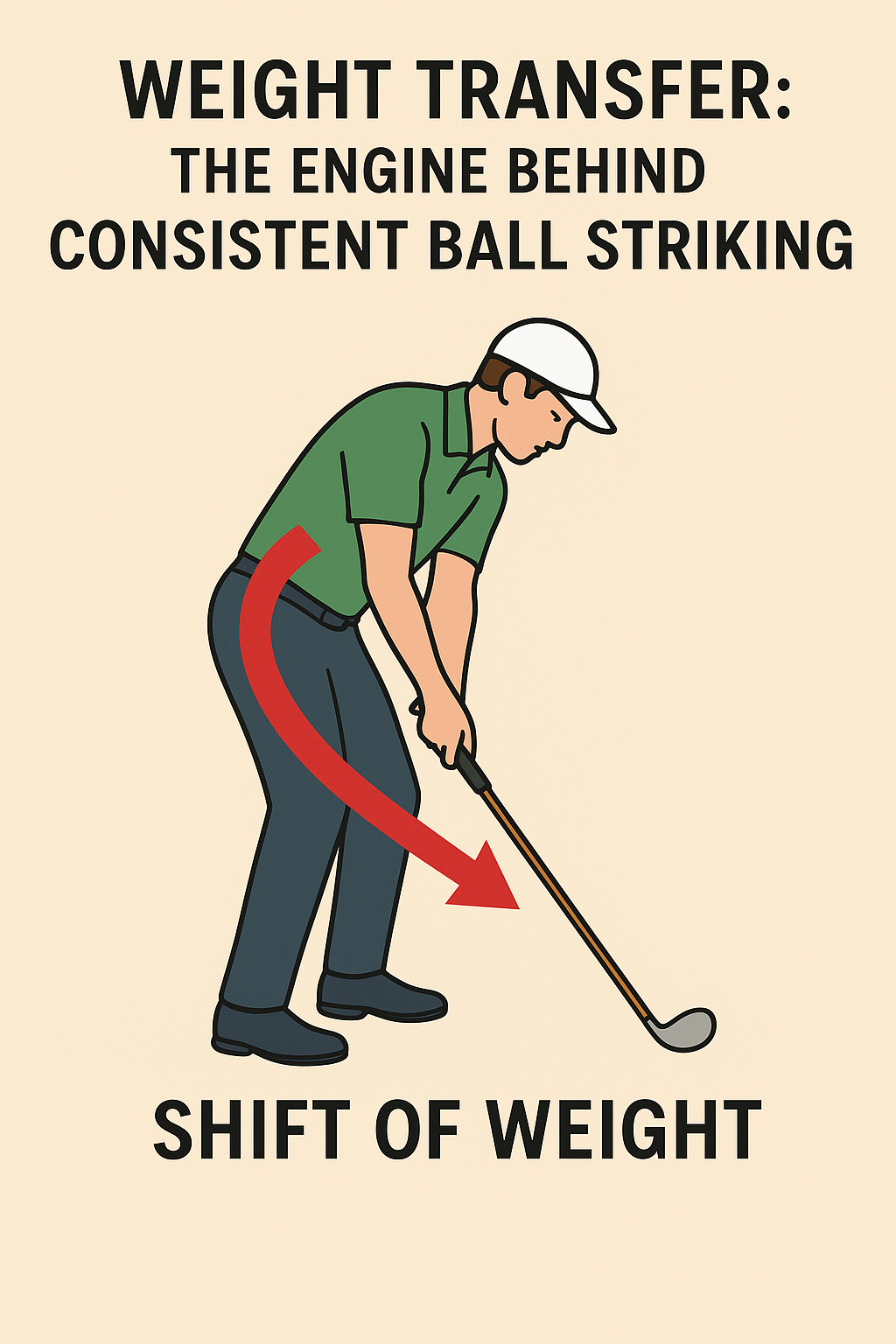
Weight Transfer: The Engine Behind Consistent Ball Striking
In the golf swing, the way you move your weight from the back foot to the front foot is the engine for solid contact and power. Think of your hips and legs as the movers, not just your arms. Proper weight transfer helps the clubface return to square at impact and keeps your low point consistent.
What the concept is
Weight transfer means shifting your center of gravity from your trail (back) leg toward your lead (front) leg as you swing, with control over when and how far you move. The transfer starts in the downswing, as your hips rotate and your torso unwinds, and it should finish with most of your weight on the lead foot at impact and into your follow-through. It’s not a rush; think coordinated, gradual movement that preserves your spine angle and balance.
Why it matters
- Consistent contact: moving weight forward helps the bottom of the swing arc reach the ball consistently.
- Better compression and clubface control: proper weight shift helps the face square up at impact.
- Improved power and balance: a controlled transfer reduces compensations like flipping the hands or swaying off the ball.
What you should feel
- At the top of the swing, your weight is slightly toward the trail foot.
- During the downswing, your weight shifts toward the lead foot as your hips rotate and your torso unwinds.
- At impact, the majority of your weight is on the lead foot with a comfortable knee flex; you still maintain spine angle and balance.
2–3 common mistakes and fixes
- Mistake 1: Weight stays on the back foot through impact. This leads to thin or weak contact and loss of power.
- Fix: Feel a deliberate, small forward press into the lead foot as you approach impact. Practice with half-swings, focusing on transferring weight to the lead foot by the time you reach the ball.
- Mistake 2: Hips stop rotating too early or too much forward movement takes over. This disrupts sequencing and can cause blocking shots.
- Fix: Drive the hips through impact while your arms follow. Keep your spine angle constant and think of rotating the belt buckle toward the target as you transfer weight.
- Mistake 3: Lateral sway or head movement rather than a true weight shift. You “swing your hips” without truly moving your center of mass.
- Fix: Use a small balance cue: keep your head over a narrow two-foot zone while you practice. Use a mirror or video to ensure you’re not sliding sideways; focus on a smooth hip rotation and forward shift.
One easy drill to ingrain it
Drill: Step-Through Weight Transfer
- Starting position: feet together, ball opposite your lead foot. Hold a light club.
- Take a half-swing, then as you start the downswing, step your lead foot forward to land about a foot in front of its address position. Your weight should transfer onto the lead foot as you rotate through.
- Finish with your chest facing the target, weight on the lead foot, and a balanced, athletic posture.
- Do 8–12 reps, 2–3 sets. Keep your spine angle and tempo smooth, not rushed.
- Tip: practice on carpet or a mat at home to keep your balance, and then try on the range with real turf.
Weight Transfer: Teh Engine Behind Consistent Ball Striking
What is Weight Transfer?
Weight transfer refers to the purposeful and coordinated movement of your body’s center of gravity
from one part of your stance to another during the swing or stroke.In most ball-striking sports,
success hinges on a smooth, timed shift of weight from the back foot to the front foot.This shift
powers the kinetic chain—from the ground up—so your hips, core, and torso can unleash rapid, precise
club, bat, or racquet speed at impact.
When weight transfer is executed well, you feel grounded, balanced, and connected to the ground. When
it’s off, contact fidelity drops, timing becomes inconsistent, and power leaks away as you chase the ball
rather than meet it cleanly. the goal is not to “stand tall” or to slam weight forward; it’s to orchestrate
a controlled, sequential transfer that optimizes leverage, control, and timing.
In practice, weight transfer is a blend of biomechanics and motor learning. it involves ground reaction forces,
body sequencing,and rhythm. athletes across golf, baseball, tennis, and cricket rely on a repeatable weight
transfer pattern to produce consistent ball striking.
Biomechanics of a Fluid Weight Shift
A sound weight transfer starts with a stable setup and a relaxed, athletic posture. From there, the body
acts as a kinetic chain:
- Ground reaction forces drive the initial loading and leg drive.
- The hips initiate rotation, followed by the torso and shoulders in a coordinated sequence.
- The center of mass travels over a moving base of support as you transfer weight toward the front side.
- Core control and arm/club or bat/wrist action synchronize to deliver efficient impact with minimal loss of energy.
Timing is crucial.If the weight transfer occurs too early, you risk blunting the acceleration or losing
balance. If it’s too late, you may dramatically reduce the effective speed at impact. The sweet spot is a
fluid, well-timed transition that preserves energy and maintains posture through the strike.
Key Phases of Weight Transfer in a Typical Swing
Think of weight transfer as a four-beat sequence that mirrors most prosperous swings across sports.
- Set-Up and Load (Backside) — Establish a solid base with slight knee flex, chest over the midline, and the majority of weight on the trail leg.The goal is to feel ready rather than rushed.
- Load and Coiling (Backswing) — The trail-side weight shifts toward the back leg as the hips rotate. The torso and arms coil, storing elastic energy like a spring.
- Transition and Unload (Move to Front) — Weight shifts toward the front foot while the hips open,releasing the stored energy into the downswing. The torso squares toward the target, and the arms guide the release.
- Impact and Through-Release (Front Side) — Most weight is on the front foot as you strike the ball, followed by extension and a stable finish, ensuring consistent contact and direction.
Weight Transfer Across Sports
While the specifics vary by sport,the underlying principle remains: controlled weight shift toward the point of contact
improves timing,power,and accuracy. Here’s how weight transfer manifests in different ball-striking disciplines:
- Golf — Transfer from the back foot to the front foot during the downswing to maximize power without losing balance.
- Baseball — Forward weight shift through the hitting zone enables a deeper impact point and better exit velocity.
- Tennis — Ground-based weight transfer supports aggressive groundstrokes and maintains control on heavy balls.
- Cricket — A precise transfer helps generate bat speed while staying balanced through the shot.
Practical Drills and Cues to Train Weight Transfer
Consistency comes from deliberate practice. Use these drills to ingrain the feel of a reliable weight-shift pattern.
- toe-Tap Drill — In stance with minimal upper body movement, tap the toe of the trail foot lightly on the ground as you rotate into the backswing. This builds awareness of weight loading without overcomplicating the motion.
- Step-Through Drill — After contact, take a small step toward the target while maintaining balance.This encourages forward weight shift through impact and into the finish.
- Wall drill (Backswing Load) — Stand a few inches from a wall with your trail-side hip touching it lightly. As you begin your backswing, feel the wall guiding the initial weight load while keeping your spine angle intact.
- Medicine Ball rotation — Hold a light medicine ball near chest level. Perform a controlled rotation and transfer weight from back foot to front foot as you rotate, emphasizing sequence rather than speed.
- Mirror Feedback Drill — Practice with a mirror placed to show your hip and shoulder alignment. Focus on the moment your weight begins to shift forward and how your hips open through impact.
Benefits and Practical Tips for Mastery
- Increased Consistency: A repeatable weight transfer pattern reduces the variance in contact point and ball flight.
- Improved Power with Control: Ground-up loading translates to faster club head speed without sacrificing accuracy.
- Injury Prevention: Proper sequencing reduces compensations that strain the lower back, hips, and shoulders.
- Better Contact Quality: Weight over the midline at impact helps stabilize the clubface or bat face for cleaner hits.
- Adaptability: A solid base of weight transfer improves performance across weather conditions, varies in ball position, and different swing tempos.
Pro tip: Don’t chase velocity alone.Emphasize the quality of the transfer first, then gradually increase tempo as your body learns the pattern.
Case studies: Real-World Impacts of Weight Transfer
These concise examples illustrate how a focused approach to weight transfer translates into tangible on-field improvements.
Case Study A — Amateur Golfer
An amateur golfer with a tendency to “flip” hands and reach for the ball reduced consistency in ball striking.
After a 6-week program focused on depth of weight transfer, sequencing, and a simple cue—“stay loaded on the trail leg until the hips rotate”—the player recorded steadier contact and a noticeable enhancement in accuracy across mid-irons.
case Study B — Baseball Hitter
A youth baseball hitter struggled with late swings and inconsistent line drives. Implementing a drill sequence emphasizing forward weight shift and front-side drive improved ball contact and exit velocity by a measurable margin.The hitter learned to transfer energy from the rear foot into the front-side drive, producing a firmer, more repeatable swing path.
Case Study C — Tennis Player
A competitive tennis player relied on upper-body rotation with minimal leg drive, leading to heavy balls with inconsistent depth. By reinforcing hip- and core-led weight transfer and integrating it with groundstrokes, the player achieved more stable groundstrokes, better depth, and improved timing on faster serves.
First-Hand Experience: A Coach’s Perspective
In teaching weight transfer,I often start with feel rather than physics. I tell students to imagine pulling
their weight from the back foot into the front foot as they strike the ball, then to hold that feeling through
impact. The moment the weight shifts forward, the swing becomes more stable, and contact tends to improve.
I’ve seen players who previously struggled with timing begin striking the ball more consistently after emphasizing the transition
phase—tracking the moment their hips open and their center of gravity moves forward. The coaching cue “drive off the trail foot”
becomes a reliable mental anchor, especially under pressure in fast-paced games.
Quick Reference: Phases and Drills
Phases of Weight transfer: Quick Reference
| Phase | Description | Cues |
|---|---|---|
| Setup | Neutral,athletic posture with balanced weight between feet. | Soft knees, chest over midline, relaxed shoulders |
| Load/Backswing | Weight shifts toward the trail leg; hips rotate to coil energy. | Feel the load, hinge at the hips, stay connected to ground |
| Transition | Weight moves toward the front foot; hips open to target. | Lead with hips, stay behind the ball, maintain posture |
| Impact/Release | Front-side weight bear-down; extension through contact. | Solid contact, quick turnover, follow-through to finish |
Drills at a Glance
| Drill | Purpose | How to |
|---|---|---|
| Toe-Tap Drill | Awareness of weight shift without overpowering technique | Tap trail toe lightly on every backswing, maintain posture |
| Step-Through Drill | Encourages front-side loading and forward momentum | After impact, take a small target-directed step |
| Medicine Ball Rotation | Dynamic transfer and rotational power | Hold ball at chest, rotate hips and torso while keeping stance |
| wall Drill | Feedback on back-to-front weight shift and spine angle | Stand a few inches from wall; initiate backswing while feeling contact |
Frequently Asked Questions
- Is weight transfer the same for golf and baseball?
- Conceptually yes: both rely on shifting energy from the back side to the front side to maximize impact speed and accuracy. Details vary with grip, stance, and swing arc between sports.
- What happens if I shift weight too early?
- Early forward weight transfer can blunt hip rotation, reduce coil, and lead to inconsistent contact or pushing the ball to the wrong side.
- How quickly should the transfer occur?
- There is no universal timetable. The transfer should be timely within your swing’s rhythm, aligned with your hip rotation and trunk unwind for optimal speed at impact.
- can relying on weight transfer cause knee pain?
- Improper sequencing can place extra load on joints. Focus on balanced flexion, a stable base, and gradual tempo progression. If pain persists, consult a coach or clinician.