
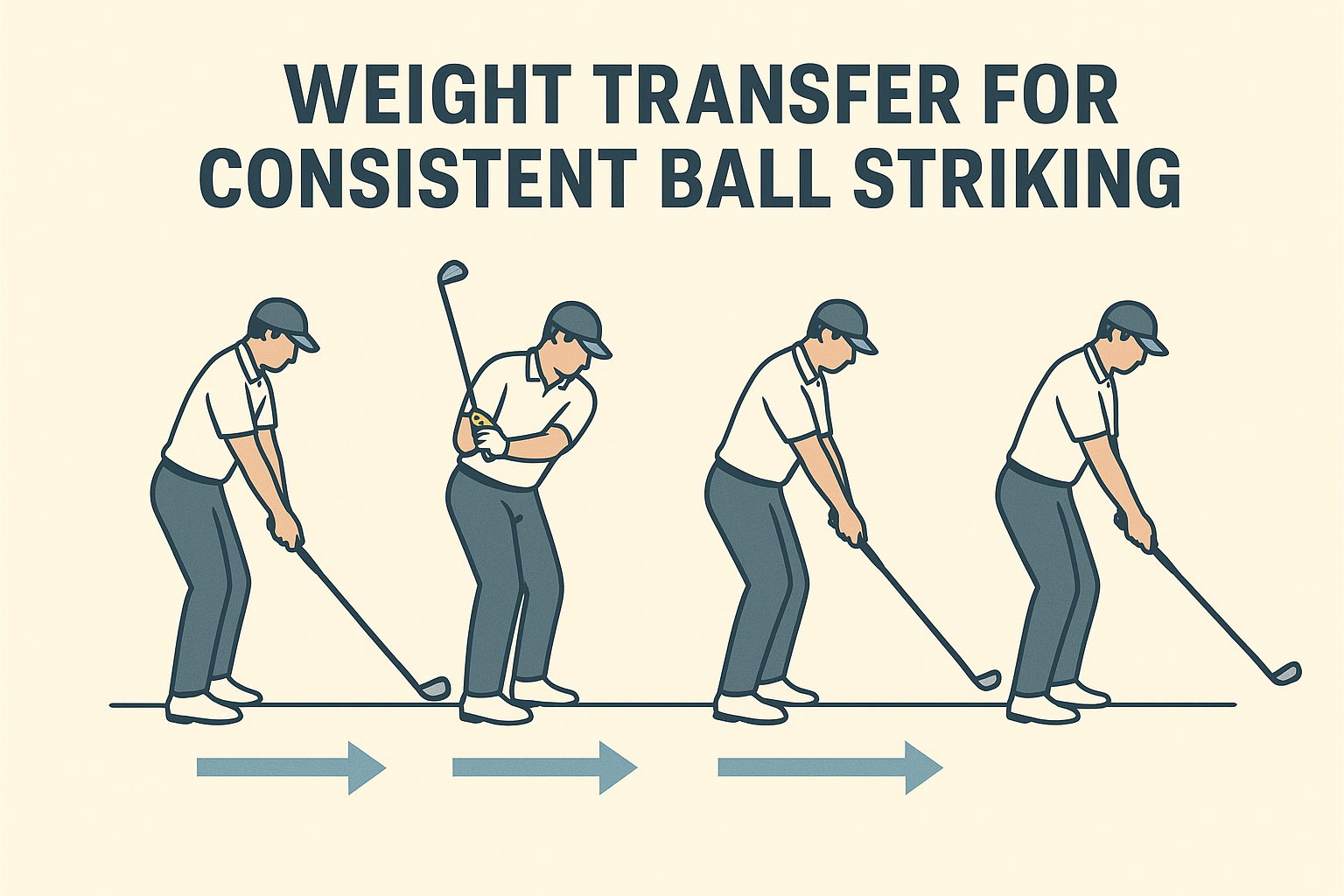
Weight Transfer for Consistent Ball Striking
Today we’re focusing on one essential, repeatable element of the golf swing: weight transfer. This means moving your body’s weight smoothly from your trail foot (the right foot for right-handers) to your lead foot (the left foot) as you swing. It’s a foundational detail that influences contact, distance, and accuracy without requiring a lot of separate mechanics to remember.
What the concept is
- Weight transfer is the organized shift of your center of gravity from back to front during the swing, with a clear transition from the backswing to the downswing and through impact.
- In a good sequence, you load on the trail foot in the backswing, then rotate toward and land on the lead foot as you strike the ball, finishing balanced on the lead side.
Why it matters to the golf swing
- Solid weight transfer helps strike the ball cleaner and compress it, improving distance and consistency.
- Proper transfer reduces “hit behind” or “fat/thin” shots caused by staying too far back or rushing weight forward too early.
- It supports solid spine angle, better clubface control through impact, and steadier balance in the finish.
What the golfer should feel when doing it correctly
- During the backswing, feel a light load on your trail foot (right foot for right-handers) without collapsing your posture.
- As you start the downswing, feel your hips rotate and your weight visibly move toward the lead foot.
- At impact, your weight is largely on the lead foot, with the trail foot starting to unload and the chest pointed toward the target.
- Finish in a balanced position on the lead side, as if you could hold a pose without wobbling.
2–3 common mistakes and simple fixes
- Mistake 1: Weight stays on the trail foot through impact
Fix: Start your downswing with a deliberate hip rotation that carries your weight forward. Practice without a ball first, using slow half-swings and pausing briefly at impact to check you’re on the lead foot. Imagine you’re writing a line toward the target with your sternum; you want that line to cross to the lead side at impact. - Mistake 2: Weight transfer happens too early or too late
Fix: Build a two-stage feel: (1) load on the trail foot during the backswing, (2) shift to the lead foot through the downswing and impact. Use tempo drills (see drill below) to synchronize the transition, ensuring the move into the lead side happens as the club approaches the ball rather than before or after it. - Mistake 3: Excessive lateral slide with little hip rotation
Fix: Emphasize a turning hip move rather than a pure slide. Keep your feet planted while allowing your hips to rotate toward the target. This helps your weight transfer feel “pivot-based” instead of “swivel-sway.” A simple cue: imagine your belt buckle aiming at the target as you rotate through impact.
One easy practice drill you can do at home or on the range
- Step-Through Weight Transfer Drill:
- Stand with your feet hip-width apart and take a light grip on a club or a weighted object (no ball needed).
- Make a small backswing, then begin the downswing and step your lead foot forward about 6–8 inches as you approach impact. Your weight should move onto the lead foot around impact, with your trail foot barely touching the ground by the finish.
- Hold the finish briefly, then reset to the starting position. Repeat 15–20 reps, focusing on a smooth, coordinated shift rather than a speed rush.
- Progress to swinging at a ball with the same feeling, keeping the rhythm steady and balance intact.
Consistency comes from feeling this transfer, not from trying to muscle the motion. If you stay tall, let your hips rotate, and think “weight to lead foot at impact,” you’ll see more solid contact and truer flight paths. Practice this with patience, and you’ll build reliable ball striking that holds up across your clubs and shots.
Weight Transfer for Consistent Ball Striking
In golf, as in many precision sports, how you move your weight during the swing directly influences contact quality, distance control, and accuracy. Weight transfer is the deliberate,coordinated shift of your body’s weight from the back foot toward the front foot during the swing. When done correctly,it helps you deliver the clubface square to the ball at impact,promoting consistent ball striking across different clubs and shot trajectories. This article breaks down the biomechanics,benefits,practical tips,and proven drills to sharpen your weight transfer for better scores on the course.
Understanding Weight Transfer in the Golf Swing
Weight transfer is not a single event but a sequence of coordinated movements that starts from setup and continues through impact.For most right-handed players, the path typically involves loading the trail (right) leg in the backswing, storing potential energy, then unloading that energy into the lead (left) leg as you strike the ball. Proper timing ensures the clubhead reaches the ball with optimal speed and a stable swing path.
Key biomechanical concepts
- Center of gravity and balance: Maintaining a stable center of gravity allows the hips and torso to rotate freely while the feet provide a solid base. A balanced setup makes it easier to transfer weight smoothly without sliding or flipping the hips prematurely.
- Ground reaction forces: The flooring under your feet generates forces that propel the body through the swing. Efficient weight transfer converts ground reaction forces into clubhead speed without sacrificing control.
- Sequencing of hips, knees, and ankles: A natural flow—hips initiating the downswing, followed by the knees and ankles—helps prevent early extension or over-rotation, both of which can disrupt contact.
- Load and unload pattern: You load weight onto the trail foot during backswing and unload onto the lead foot during downswing and through-impact, transferring pressure forward as speed increases.
Common motion patterns and how they affect contact
- Too much weight on the trail foot at impact: Leads to steeper swings, toe-first contact, and inconsistent ball striking.
- Early reverse weight shift: Causes late impact, off-center strikes, and loss of distance control.
- Balanced transfer with forward shaft lean: Promotes solid contact, compression, and accurate ball flight.
Benefits of proper Weight Transfer for Ball Striking
- Improved contact quality: By aligning the center of mass with the ball at impact, you reduce mis-hits and produce more centered strikes.
- Better distance control: Consistent speed generation through efficient weight transfer translates to predictable carry and rollout.
- Enhanced accuracy: A stable base and proper sequencing help you maintain swing path and face alignment, reducing shot dispersion.
- injury prevention: Efficient loading and unloading minimize compensations in the lower back, hips, and knees.
- Club-specific benefits: Different clubs demand different launch characteristics; proper weight transfer helps you achieve stable impact across wedges, irons, and drivers.
Practical Tips to Train Weight Transfer
Incorporating deliberate practice into your routine will translate to on-course gains. Use these cues and checks to build a repeatable weight transfer pattern.
- Setup and posture: Maintain a athletic, slightly hinged posture with weight evenly distributed between the balls of your feet and a comfortable slight knee flex. Think of a stable base that’s ready to move in any direction.
- Quiet feet, active hips: Keep your feet grounded and minimize foot wobble. Let your hips initiate weight transfer on the downswing to avoid compensations from the upper body.
- Trail-to-lead weight shift cue: On the backswing, feel the weight slide into the trail heel or the center of the trail foot. On the downswing, imagine driving the weight into the lead foot as you rotate through impact.
- Lead arm and body connection: Keep the lead arm connected to your chest through impact to promote a stable transfer of energy rather than a breakdown in posture.
- Balance checks: Periodically pause at the top of the backswing for a second to feel weight on the trail foot, then complete the swing while maintaining balance as you transfer forward.
- Foot pressure awareness: Use a pressure mat or simple mirror checks to observe how weight shifts from heel to midfoot to toe during the swing.
Drills and Practice Routines
Effective drills focus on creating a repeatable transfer pattern. Start slow, then gradually increase tempo as your body becomes more comfortable with the motion.
| drill | Focus | Cue | How to Perform |
|---|---|---|---|
| Step-Through Weight Transfer | awareness of weight loading and unloading | Step toward target after contact | Set up with feet shoulder-width apart. Take a half backswing,feel weight shift onto trail foot,then step forward with lead foot through impact. Repeat 8–12 reps per side. |
| Pause and Pulse | Sequencing and timing | Pause at top, then drive forward | Take the swing to the top, pause 1–2 seconds, focus on loading trail leg, then press weight into lead foot through the ball. Do 6–8 reps with a shorter takeaway. |
| Feet-Only Drill | Footwork and balance without the club | Feel the ground reaction forces | Stand with the club resting on the chest. Move through the backswing and downswing using only hip rotation and weight transfer; monitor balance without hitting a ball for 6–8 reps, then add the club gradually. |
| Pressure-Shift Drill | Weight distribution across the foot | Maintain pressure on the lead foot at impact | Place a small object under the lead foot and practice a smooth shift of pressure from trail to lead foot during the swing. Aim for a clean, centered contact on the ball after 8–12 reps. |
Notes on the drills
- Focus on sensation first, technique second. The goal is a repeatable feel of loading and unloading energy, not perfect speed from the start.
- Gradually increase tempo. Speed can reveal and reinforce flawed patterns, so progress in small increments.
- Video your swings. A simple phone camera from face-on and down-the-line angles helps you verify whether weight transfer is occurring as intended.
Common Mistakes and How to Fix Them
Even experienced golfers struggle with weight transfer at times. Here are frequent errors and practical fixes to keep you on track.
- early extension: The hips move toward the ball too soon, blocking proper weight shift. Fix: Maintain hip tilt and rotate around a steady spine angle; feel the chest staying over the ball longer while loading the trail leg.
- Reverse weight shift: Pressure moves toward the lead foot too early, causing off-center contact.Fix: Pause briefly at the top, ensure the trail heel is loaded, then transfer weight smoothly toward the lead foot as you rotate through impact.
- Excessive weight on the trail heel at impact: Slows acceleration and reduces contact consistency.Fix: Aim to feel even pressure from the inside of the trailing foot to the midfoot, then toward the lead foot in the final step.
- Swing path deviations: A push-draw or pull-fade pattern can mask poor weight transfer. Fix: Reintroduce the basics: proper stance width,balanced posture,and deliberate weight transfer during the downswing.
Case Studies and firsthand Experience
Real-world examples help illustrate how weight transfer translates to sheet performance on the course. The following anonymized case studies summarize common progressions and outcomes.
Case Study 1: Mid-handicap to Consistency
A 12-handicap player struggled with inconsistent irons, frequently contacting the ball high on the face. After a six-week program emphasizing weight transfer drills, they reported improved contact and a more consistent shot shape. The key changes were
- Improved loading of the trail leg during the backswing,
- Clear downswing transition with a deliberate shift of weight to the lead foot,
- Better balance at impact, leading to more centered iron strikes and a stable divot pattern.
Case Study 2: Driver Consistency
A golfer who frequently enough missed left and lacked distance relied on aggressive hip turn but failed to transfer weight correctly.Working on a forward weight transfer cue, they learned to transfer energy more efficiently into the lead foot, resulting in more predictable ball flight and longer drives with tighter dispersion. The betterment was most noticeable when switching to different driver lofts and ball positions, where consistent weight transfer reduced the variability between clubs.
Drill Progression and Measuring Success
To progress your weight transfer practice, combine a structured drill sequence with simple feedback indicators. Track these metrics over weeks to gauge progress:
- Contact location visuals (center vs. toe/heel).
- Shot dispersion with standardized club and target settings.
- Ball speed consistency across the same club and different rounds.
- Pressure distribution patterns using a simple balance mat or a wearable sensor in advanced setups.
Consistency comes from repeating the same transfer pattern under different conditions. The drills above are designed to reinforce that pattern so you can reproduce it on the course without overthinking.
Equipment, Aids, and How to Use Them
technology and practice aids can accelerate your understanding of weight transfer. use these tools judiciously to support your coaching and practice sessions.
- Compare your swing to a model and watch for the moment when weight shifts away from the back foot.
- Launch monitor metrics: Monitor ball speed, launch angle, and carry to infer the quality of weight transfer and impact.
- Pressure mats or wearable tech: Visualize foot pressure changes and quantify lead-foot loading,trail-foot unloading,and center-of-pressure path.
- Grip and stance aids: Ensure your body is aligned with the clubface through impact to support consistent weight transfer.
Content and SEO-Driven Optimization for Weight Transfer
To maximize search visibility for readers seeking guidance on weight transfer and consistent ball striking, weave these related keywords naturally into headings and body copy:
- Weight transfer in golf
- Consistent ball striking
- Golf swing sequencing
- Ground reaction forces golf
- Balance and stability golf swing
- Backswing loading and downswing unloading
- Center of gravity golf
- Lead foot and trail foot in swing
FAQ: Rapid Answers on Weight Transfer
- Why is weight transfer crucial for ball striking?
- It helps align the clubface at impact, stabilizes the swing path, and delivers consistent contact and distance.
- How can I feel weight transfer during practice?
- Use cues like “load the trail foot, then press into the lead foot” and check balance in the mirror or with a camera!
- What’s the best way to start improving weight transfer?
- Begin with slower, drill-based practice focused on loading and unloading the trail and lead feet, then gradually increase speed.
Conclusion-Free Takeaway: Key Signals to Watch
While you don’t need to overhaul your entire swing, small adjustments in how you load and unload weight can have outsized effects.If you notice inconsistent strikes, look first at your weight transfer pattern: are you loading correctly on the backswing and unloading through impact? Do you feel a stable base during the downswing? By prioritizing balance, sequencing, and controlled pressure shifts, you can unlock more consistent ball striking across your clubs.
Take-action checklist
- Audit your setup: athletic posture, balanced weight distribution.
- Practice the drills above with a focus on trail-to-lead weight transfer.
- Record and review: use video analysis to confirm transfer timing and impact location.
- Gradually reintroduce course conditions: practice with different clubs, slopes, and wind to test transfer accuracy.
By embracing deliberate weight transfer as a core swing principle, you’ll see greater consistency in ball striking, improved distance control, and more reliable greenside performances. Keep practicing with intention, measure progress, and enjoy the feel of a swing that moves with purpose from start to finish.