
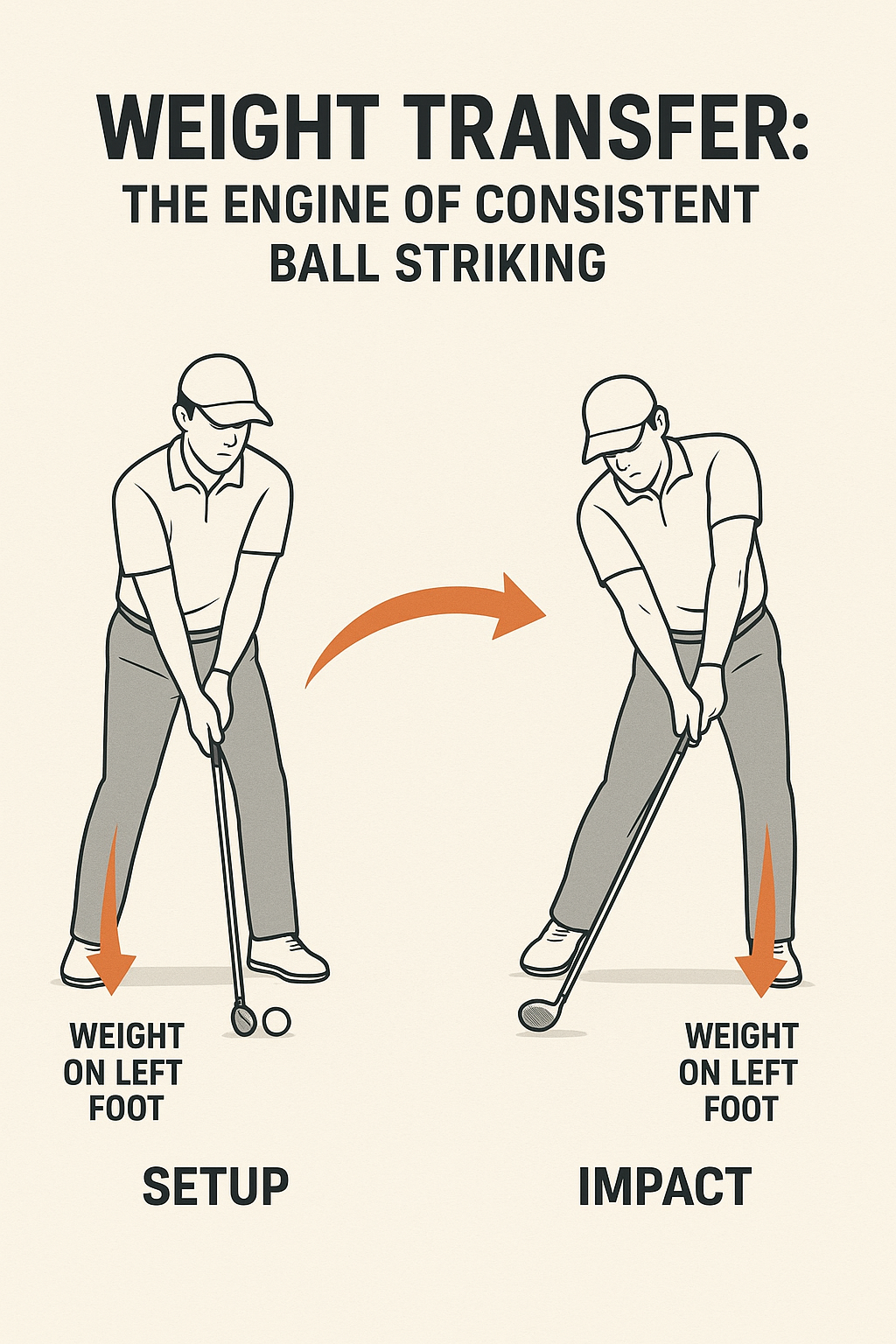
Weight Transfer: The Engine of Consistent Ball Striking
To keep things simple and focused, this post zooms in on one critical aspect of the golf swing: weight transfer. You’ll learn what it is, why it matters, what you should feel, common mistakes, quick fixes, and a simple drill you can do at home or on the range.
What the concept is
Weight transfer is the controlled move of your body’s weight from the trail foot (the right foot for a right-handed golfer) to the lead foot (the left foot for a right-handed golfer) from the top of the backswing through impact. A good transfer means you start with balanced pressure, gradually load onto the lead side during the downswing, and finish with most of your weight on the lead foot.
Why it matters to the golf swing
- Improved contact: moving your weight correctly helps you strike the ball with the center of the clubface more often.
- Consistent ball flight: proper transfer stabilizes your low point and reduces fat shots (hitting behind the ball) or thin shots (hitting the ball on the upswing).
- Distance control: a smooth, full transfer helps generate clubhead speed without over-swinging.
- Balance and tempo: a steady shift prevents you from standing upright or falling back, which can derail your swing sequence.
What you should feel when doing it correctly
- During the downswing, you feel the pressure move from the trail foot toward the lead foot.
- Your chest and hips gradually rotate toward the target as weight shifts forward.
- You finish with most of your weight on the lead foot and your body balanced over that foot.
- There’s no abrupt, jerky jumping forward; the shift is smooth and controlled.
2–3 common mistakes and quick fixes
- Mistake 1: Hanging back on the trail leg
- What happens: The trail leg stays loaded and the weight never fully moves to the lead side, causing thin or lazy contact.
- Fix: Start the downswing with a deliberate hip rotation to drive weight toward the lead foot. Think: “drive the belt buckle toward the target.” Practice pauses at impact without rushing.
- Mistake 2: Weight moves forward too early
- What happens: The weight shifts too soon, often leading to high-fat or weak contact and loss of speed.
- Fix: Maintain posterior and spine angle a bit longer in the downswing, then complete the forward transfer through impact. A cue is “rotate, then release”—rotate the hips first, then allow the weight to ride onto the lead foot as you strike the ball.
- Mistake 3: Excessive lateral slide without rotation
- What happens: The hips slide toward the target rather than turning, which can throw off balance and accuracy.
- Fix: Emphasize a turning motion of the hips over a sliding motion. Use the cue of “belly button to target” to encourage rotation alongside the weight shift.
One easy drill you can do at home or on the range
Step-Through Weight Shift Drill (no ball needed at home, or with a short swing on the range):
- Set up in a comfortable, athletic stance with your weight evenly distributed.
- Take a small, half-speed backswing to a comfortable stop.
- Begin the downswing by rotating your hips and stepping your lead foot toward the target (a small stride or step is fine). The goal is to finish with most of your weight on the lead foot and your chest facing the target.
- Pause briefly at the finish, then repeat 8–12 times, focusing on a smooth, continuous transfer rather than a fast, jerky move.
- If you have a mat or markers, try keeping your trail foot light on the ground as you shift, so you’re not “driving through” with the back foot.
Tip: keep your head fairly still and your spine angle consistent throughout the drill. Focus on a balanced finish with weight on the lead foot. Start slow, then gradually increase speed as you feel the transfer more naturally.
Bottom line
Effective weight transfer is not about rushing forward or slamming your weight onto the lead foot. It’s a smooth, controlled shift that happens as your hips rotate and your arms release through impact. Mastering this single aspect will improve your contact, increase consistency, and help you hit the ball where you aim more often.
Weight Transfer: The Engine of Consistent Ball Striking
What is Weight Transfer and why it Matters
Weight transfer is the deliberate and timed movement of your body’s center of mass from one part of the stance to another during contact with the ball. It’s not just about shifting your weight for a moment; it’s about creating a smooth,coordinated flow of energy through the kinetic chain—from the ground up to the club,racket,or bat. When weight transfer is well-timed, you maximize the transfer of ground reaction forces into the ball, improve contact quality, and produce more consistent ball striking.
in practical terms,weight transfer helps you:
- Maintain balance and stability through impact
- Increase clubhead speed or racquet speed without sacrificing control
- optimize launch angle and spin characteristics for better trajectory
- Reduce the likelihood of off-center hits and mis-hits
- Protect joints by distributing load through a safe,athletic sequence
While the term is widely used across sports—golf,tennis,baseball,and beyond—the core principle remains the same: load,transfer,and release energy in a controlled,repeatable pattern. The “engine” of consistent ball striking is how well you load into your trail side, how efficiently you transfer that energy toward the contact point, and how cleanly you release it at impact. The better this engine runs, the more repeatable your results become, regardless of your skill level.
Biomechanics of Weight Transfer
The Kinetic Chain and Sequencing
Weight transfer is a biomechanical process that involves multiple joints acting in concert. The sequence typically begins with a stable base, then a coiled trunk, and finally a forward shift of the hips and torso toward the target. The feet, ankles, knees, hips, spine, shoulders, and arms—all contribute to the moment when contact is made. When sequencing is smooth,energy generated from the ground travels from the ground to the legs,through the core,and into the object you’re trying to strike.
Phases of the Swing or Stroke
- Loading phase: The trail-side leg and hip store energy as you coil and prepare to rotate.
- Transition phase: The hips and torso begin to unwind, shifting weight toward the lead side.
- Impact phase: The weight is transferred through the front foot, promoting solid contact and forward acceleration.
- Release phase: Energy continues to flow into the ball, with follow-through completing the arc.
Ground Reaction Forces and Balance
What happens on the ground matters. The ground reaction force vector moves from the trail foot to the lead foot as you rotate, creating a stable base for the club or implement to strike the ball. In practical terms, you’ll often feel a subtle loading of the back foot early in the swing and a deliberate push-off into the lead foot at impact.Maintaining a dynamic balance—neither rigid nor flailing—helps you deliver a cleaner strike and repeatable results.
Weight Transfer in Different Sports
Golf: Precision Through Ground-to-Club Connection
In golf, weight transfer is the bridge between power generation and film-like precision. A well-timed weight shift helps you shallow the angle of attack, keep the swing under control, and deliver a consistent impact location.Common cues include maintaining knee flex, rotating the hips toward the target, and ensuring the trail heel remains light enough to promote late-stage transfer without collapsing the knee.
- backswing: store energy by coiling with the weight mostly on the trail foot.
- Transition: Initiate a smooth forward move with a hip-rotational cue, transferring weight to the lead foot.
- impact: Contact occurs when the weight is firmly on the lead foot, with a slight forward tilt of the torso for solid compression into the ball.
Tennis: Groundstrokes and the forward Drive
Tennis relies heavily on rapid, dynamic weight transfer to generate pace and control. The split step prepares you to react, and the subsequent forward shift helps you drive through the ball. On forehands and backhands, imagine stepping into the shot and letting the hips and torso rotate in unison to direct energy from the ground into the racquet face.
- Ready position to contact: a deliberate, athletic transfer from the back foot to the leading foot.
- Forehand emphasis: early forward shift with shoulder rotation for clean contact.
- Backhand emphasis: similar transfer pattern with appropriate alignment to the ball’s path.
Baseball/Softball: The Load-Up and Launch
In baseball swings, weight transfer powerfully influences bat speed and ball exit velocity. Proper loading in the back leg, followed by a forceful drive toward the front leg, helps you maximize bat speed through the zone. A common cue is to “load and explode” with the hips, maintaining posture and keeping the front shoulder aligned with the ball as you make contact.
- Load phase: Weight increases on the back leg as the pitcher or pitcher-like delivery starts.
- Stride and rotation: The front foot lands, weight shifts forward, hips rotate ahead of the hands.
- Impact: Energy is transferred through the torso,into the hands,and into the bat at impact.
Benefits of Proper Weight Transfer
- Consistency: Repeated,reliable contact quality across swings and shots.
- Power and Speed: Efficient energy transfer translates to higher ball speed without excessive effort.
- Accuracy: Decelerated, controlled energy flow improves aim and trajectory control.
- Injury Prevention: Balanced loading reduces peak stresses on joints and soft tissues.
- Age and Skill Versatility: A sound transfer pattern helps players of all levels adapt to different speeds and equipment.
Practical Tips and Drills
These tips and drills help you internalize the weight-transfer sequence and turn it into a repeatable part of your technique. Practice slowly at first, then gradually increase speed while maintaining form.
- Root and Align: Start with a narrow, athletic stance. Feel weight on the back foot, then breathe out and shift toward the lead foot as you initiate the motion. Your center of gravity should glide smoothly from heel to toe across the stance.
- Coil and Uncoil: practice torso and hip rotation without rushing to impact.Build a deliberate coil on the trail side,then unwind toward the lead foot exactly at contact.
- Lead Foot Focus: During practice swings, imagine you’re stamping softly on the lead foot at impact. This helps you floor your weight transfer and stabilize the strike point.
- Breath Timing: Sync your exhale with the transition to the lead foot. A measured breath helps control tempo and avoids early or late transfer.
- Tempo Mirrors: Use a metronome or a tempo guide to keep the swing or stroke on a repeatable rhythm. Common tempos range from 60–90 beats per minute depending on sport and player size.
- Foot-Pressure Checks: Periodically check how weight feels in your feet during practice. If you notice excess weight on the toes or heels at impact, adjust stance width and knee flexibility.
| Drill | Purpose | How to Do It |
|---|---|---|
| Step-Through drill | Promotes forward weight shift | From a static stance, swing and step forward onto your lead foot, maintaining balance throughout the movement. |
| Wall Contact Drill | Maintains sequence and posture | Stand close to a wall with your back heel lightly touching it; perform a backswing and pivot forward without breaking wall contact. |
| 3-Point Balance Drill | Builds stability | Balance on each foot for 10–15 seconds, then switch; repeat for 60 seconds total. |
| Lead-Arm Only Drill | Isolates weight transfer from arm action | Take practice swings with only the lead arm, focusing on letting the weight shift through the core into the lead side. |
Additional practical cues you can incorporate after mastering the basics:
- Use a small towel under your trail foot to encourage a smooth, controlled rollover into the lead foot.
- Perform shadow swings with a light, audible exhale on impact to reinforce timing.
Common Mistakes and How to Fix Them
- Mistake: Over-rotation without proper weight transfer. Fix: Slow down the setup, pause briefly at the top of the backswing, then initiate a deliberate transfer with a coachable tempo cue.
- Mistake: Early weight shift causing early contact. Fix: Emphasize a delayed lag and maintain spine angle until the moment of impact; practice with a mirror or video for feedback.
- Mistake: Excessive lateral movement rather than forward progression.Fix: Focus on rotating hips and trunk to move energy forward,not merely side-to-side leg movement.
- Mistake: In tennis or baseball, collapsing the front knee on impact. Fix: Maintain knee flex and balanced chest position to support stable contact.
- Mistake: Poor balance during the follow-through. Fix: Finish with a controlled,solid base; avoid over-rotating beyond balance limits.
Case Studies / First-Hand Experience
Case Study 1: Golf Student with Inconsistent Contact
A recreational golfer struggled with fat and thin shots, especially with longer clubs. After emphasizing weight transfer cues—gentle loading into the trail foot, a deliberate transition of weight to the lead foot, and a clean release through impact—the student reported more consistent ball contact and improved dispersion on the driving range. The coaching focus was less on force and more on sequencing,tempo,and balance. Over six weeks, the student achieved more centered strikes, with a noticeable increase in clubhead speed and ball flight stability.
Case Study 2: Tennis Player Seeking Faster Groundstrokes
A club-level tennis player aimed to add pace without sacrificing control. The coaching plan integrated weight transfer drills with split-step timing and upper-limb synchronization. The student learned to initiate weight transfer with the hips while maintaining a compact brace through the torso.Feedback showed clearer contact and improved all-court aggression. By splitting the coaching into loading, transfer, and release phases, the player achieved faster groundstrokes while maintaining accuracy under pressure.
Quick Checklists and Metrics
- foot pressure: Are you feeling balanced pressure from heel to toe on the lead foot at impact?
- Center of mass: Does your center of mass move smoothly forward rather than dipping or swaying sideways?
- Timing: Is the weight transfer happening just before contact, not after or during impact?
- Torso sequencing: do hips and torso rotate in a coordinated sequence, leading into the strike?
- Balance in follow-through: Is the finish stable, with weight settled on the lead foot?
First-Hand Experience and Practical Insights
From coaching dozens of athletes across golf, tennis, and baseball, the recurring thread is that mastering weight transfer unlocks a higher ceiling for technique. players who focus on small adjustments—such as delaying transfer slightly, improving hip-shoulder sequencing, and maintaining a quiet lower body during impact—often see quicker gains in consistency than those chasing raw power alone. the most effective coaching language emphasizes feel: “stay light on the trail foot,” “drive into the lead foot,” and “finish with balance.” With clear cues and patient repetition, weight transfer becomes an intuitive part of every stroke or swing.
FAQ – Quick Answers for Coaches and Players
- Is weight transfer the same for all sports? The general principle is universal, but the timing and emphasis differ by sport. golf emphasizes precise contact and trajectory; tennis prioritizes rapid acceleration and control; baseball centers on bat speed and line-to-line energy transfer.
- How long should weight transfer take? In most skilled athletes, the transfer occurs in a fraction of a second, synchronized with the moment of contact. Training aims to make this transition smooth and repeatable rather than abrupt.
- Can I train weight transfer without equipment? Yes. Shadow swings, wall drills, balance exercises, and static stances can build the neural patterns and proprioception needed for effective transfer.
Putting It All Together: A Simple, Practical Plan
Use this compact plan to integrate weight transfer into your routine over the next 4–6 weeks. Aim for consistency first; power will follow as you refine timing and balance.
- Baseline assessment: Film a few cycles of your swing or stroke to observe loading, transfer, and release patterns.
- Core drills (2–3x per week): Step-Through, Wall Contact, 3-Point Balance, Lead-Arm Only drill.
- Tempo and breath: Establish a consistent exhale during transition and impact to cue timing.
- Feedback loop: Review videos with a coach or use a mirror to confirm your weight shifts are directed toward the target.
- Progressive loads: Increase speed gradually while maintaining the quality of transfer and balance.
Weight transfer is not a gimmick; it’s the scientific and practical foundation of repeatable ball striking. By focusing on the loading of the trail side, the precise transition of weight to the lead side, and a clean release through impact, athletes in golf, tennis, baseball, and beyond can elevate performance consistently. With thoughtful practice, the engine of consistent ball striking—weight transfer—becomes not just a technique, but a reliable skill that you can rely on, shot after shot, rally after rally, swing after swing.