
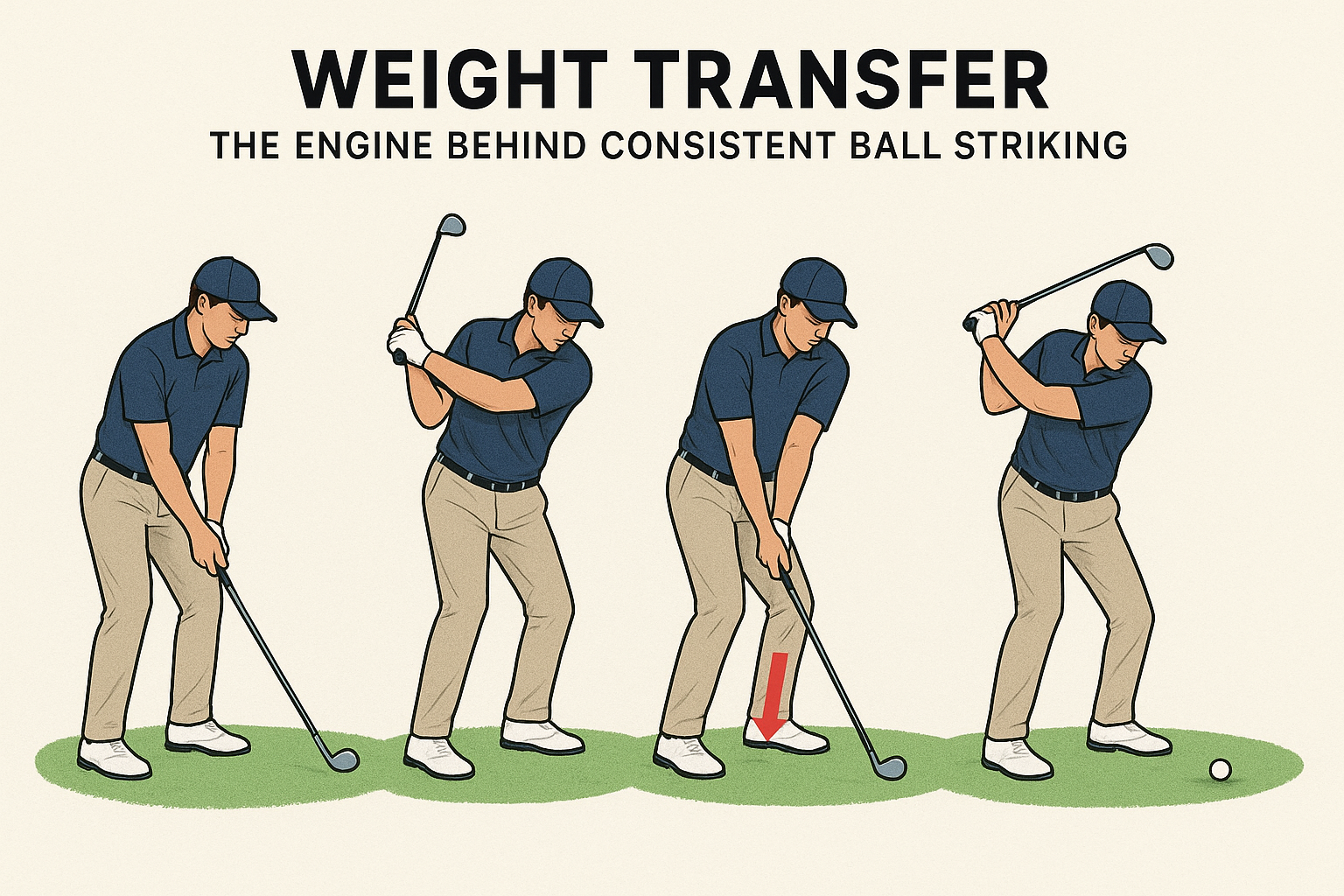
Weight Transfer: The Engine Behind Consistent Ball Striking
Today we’re focusing on one specific, repeatable element of the golf swing that makes a big difference to contact and distance: weight transfer. Think of it as the body’s way of loading and unloading into the shot. When done well, you’ll find your strikes become more centered and your shots more predictable.
What the concept is
Weight transfer is the controlled shift of your center of gravity from the trail foot (right foot for right‑handed golfers) toward the lead foot (left foot) as you swing through the ball. It’s a combination of a subtle hip rotation, a slight knee bend change, and a balanced return of pressure into the target line. The goal is to have your weight move smoothly through impact, helping the clubhead stay on plane and the face square to the ball.
Why it matters to the golf swing
- Promotes solid contact. When your weight is under control, the clubface meets the ball with a stable base, reducing producer shots off the toe or heel.
- Increases compression and ball speed. A proper forward shift helps you strike the ball more consistently on the center of the face, maximizing transfer of energy.
- Improves consistency and accuracy. A predictable weight path reduces curving shots caused by over- or under-shifting.
What the golfer should feel when doing it correctly
- You feel pressure gradually move from your trail foot toward your lead foot as you start the downswing.
- Your hips rotate toward the target while your spine stays relatively tall and centered, not dipping or swaying excessively.
- At impact, most of your weight is on the lead foot, with the trail leg still providing a pushing support rather than a dragging pull.
2–3 common mistakes and simple fixes
- Mistake 1: Weight stays on the back foot at impact (hanging back), causing thin or fat shots.
- Fix: As you begin the downswing, consciously feel your weight sliding onto the lead foot and into the ball. A simple cue is to imagine stepping toward the target with your left foot during impact, while your right foot lightens its grip on the ground.
- Mistake 2: Excessive lateral sway with little pelvic rotation, leading to loss of control and timing.
- Fix: Focus on rotating the hips rather than sliding the hips forward. A towel under the arms can help you feel the chest staying level and reduce side-to-side movement while you turn.
- Mistake 3: Too quick a forward shift before the arms have released, causing early release and inconsistent contact.
- Fix: Pause slightly at the top of the backswing and time the weight transfer with a controlled hip turn. Maintain a slight knee flex and finish with your weight solidly on the lead foot.
One easy drill you can do at home or on the range
Step-Through Weight Shift
- Set up in your normal stance. Place a small, lightweight object (like a towel or a foam block) under your trail foot to cue the weight transfer without letting it “drag.”
- Take a few slow, half-swings. As you start down, focus on letting your weight progressively move toward the lead foot and into the target line.
- At the moment of impact, picture your weight being mostly on the lead foot. Finish with a balanced, tall posture and a quiet finish where the chest faces the target and the belt buckle points toward it.
- Do 2 sets of 10 half-swings, then 2 sets of 10 full swings when you feel confident.
Consistency in weight transfer is a reliable pathway to better contact and more predictable distance. Use the drill above to train the feel, and pair it with a steady tempo to keep your transfer smooth from start to finish.
Weight Transfer: The Engine Behind consistent Ball Striking
Weight Transfer: The Engine behind Consistent Ball Striking
Weight transfer is the subtle, powerful mechanism that connects ground contact to ball contact. In golf, tennis, baseball, and other ball-and-rport sports, the right weight shift unlocks distance, accuracy, and repeatable contact. When the body moves weight efficiently from the ground up through the kinetic chain, energy becomes momentum that travels through the club or racquet with minimal loss. Mastering weight transfer isn’t about brute force; it’s about timing, sequencing, and balance.
Understanding the biomechanics of weight transfer
Weight transfer is a biomechanical process that starts at the feet and ends with a controlled, stable finish. For athletes and golfers alike, the idea is to move the body’s center of gravity in a deliberate, efficient path so that the force generated at the ground is directed into the ball. Here are the core components:
- Ground reaction forces: The ground pushes back when your foot pushes into it. Efficient weight transfer begins with a solid connection to the ground and uses that reaction force to propel the swing or stroke.
- Kinetic chain: A connected sequence—from feet to ankles, knees, hips, torso, shoulders, arms, and wrists—that converts raw ground forces into clubhead speed or racquet head speed.
- Center of gravity shift: Moving your weight toward the target (lead side in most swings) at the right moment aligns your body with the direction of the shot and promotes solid contact.
- Spine angle and posture: maintaining a stable spine angle prevents early head movement and ensures the energy travels along a predictable path.
- Timing and sequencing: Weight transfer must synchronize with hip rotation, shoulder rotation, and arm extension to prevent deceleration or off-center hits.
The sequencing: from feet to follow-through
A practical way to think about weight transfer is as a controlled pedal-to-the-metal sequence rather than a single movement. In many swings, the order looks like this:
- Set-up weight distribution: A balanced stance with a slight bias toward the trail side (the back foot) prepares you for the initial turn.
- ground-to-hip transfer: As you begin the backswing, pressure begins to load into the trail leg, storing energy for the transition.
- Hip and torso rotation: The hips start to rotate toward the target while the upper body coiling maintains spine angle. this unlocks the stored energy.
- Weight shift to the lead side: During the downswing, weight moves forward into the lead foot. The trail knee flexes naturally as energy is released through the impact zone.
- Impact alignment: The center of gravity sits over the lead leg at impact, and the body remains stable enough to avoid excessive vertical movement.
- Follow-through: Post-impact weight finishes on the lead side, with a balanced, controlled finish that mirrors the swing’s tempo.
Key cues for reliable weight transfer
- Imagine stepping into a strong,athletic stance and then “catching” your weight onto the lead foot at impact.
- Keep the head relatively still and let the hips lead the transition, not the arms.
- Maintain a slight knee flex in the lead leg through impact to absorb force and stay balanced.
- Use the ground as your ally—feel how your feet press into the ground and push energy upward and forward.
Weight transfer in practice: golf-focused insights
in golf, weight transfer is arguably the defining factor between good and great ball striking. A well-timed shift improves clubhead acceleration on the downswing, promotes solid contact on the sweet spot, and reduces the tendency to fat (hit behind the ball) or thin (hit too far above the ball) shots. Here are golf-specific considerations:
- Stance width and ball position: A slightly wider stance can help with stability during the backswing, while ball position influences when and how quickly you shift weight.
- Backswing loading: The weight bias toward the trail foot grows as you coil your upper body away from the target. This stores energy for the downswing.
- Transition timing: The downswing should begin with the hips firing toward the target, followed by the torso and arms.Early upper-body firing can stall weight transfer and reduce power.
- Impact stability: A prosperous transfer places the majority of weight on the lead foot at impact while keeping the head steady and the spine angle intact.
- Posture and finish: After impact, finish with a balanced, athletic pose that confirms your weight finished on the lead side.
Benefits of proper weight transfer
When weight transfer is executed correctly, you’ll notice a cascade of positive outcomes across performance metrics. here are the main benefits:
- increased power and distance: Efficient energy transfer through the kinetic chain translates to higher ball velocity and longer shots.
- Improved accuracy: proper weight shift stabilizes the swing path and reduces lateral drift or inconsistent contact.
- Enhanced consistency: Repeating the same weight-shift pattern leads to more repeatable ball striking and fewer mishits.
- Better tempo and rhythm: A smooth transfer helps maintain a repeatable tempo rather than a jerky or rushed action.
- Injury prevention: Balanced loading and proper sequencing reduce compensatory movements that strain the back,knees,and hips.
Practical tips and drills
Implementing weight transfer in your training comes down to deliberate practice with feedback. Below are practical tips and drills you can perform on the range or court. Start slow, then increase complexity as your awareness grows.
- : Stand with feet shoulder-width apart, hips square, light bias toward the trail foot. Place a small mirror or video camera to check foot pressure and hip rotation.
- : perform the swing in a deliberately slow tempo, focusing on the moment the weight shifts from the trail foot to the lead foot. Pause at impact to confirm weight placement.
- : After impact, step forward with your lead foot and complete a controlled follow-through. This reinforces the feeling of transferring weight into the lead side.
- : Practice initiating the downswing with a hip bump toward the target, then allow the torso to rotate. This sequencing helps avoid early arm movement and promotes clean energy transfer.
- : Stand near a wall with your lead shoulder slightly away. Place a light ball or towel under your lead heel. As you swing,press the lead foot into the wall/towel,simulating forward weight transfer while maintaining posture.
- : End each swing with a balanced finish and a quiet, controlled return to setup. Balanced finishes indicate that weight has transferred predictably.
Drills you can add to your program
| Drill | What it trains | How to perform |
|---|---|---|
| Slow-motion hip turn | Hip sequencing and torque | Stand still, rotate hips slowly 180 degrees, then reverse. Focus on feel, not speed. |
| Wall-pressure transfer | Trailing-to-leading weight shift | Place a towel under the lead heel. Tap into trail foot,then press into the towel to shift weight forward while keeping spine angle. |
| Shadow swing with weight focus | Full swing pattern without ball | Practice a full swing,focusing on a smooth weight transfer from trail to lead foot,finishing balanced. |
| Step-through finish | Post-impact stability | After contact, step into a stable lead-foot finish and hold for 2 seconds. |
| Impact bag feedback | Impact consistency | Hit an impact bag or soft target and focus on landing weight on the lead side during contact. |
Case studies: real-world examples of effective weight transfer
These short case studies illustrate how weight transfer translates to improvements in ball-striking outcomes.Note that individual results vary based on body mechanics,experience level,and practice consistency.
Case Study 1: Mid-level amateur golfer
- Challenge: Inconsistent contact, frequent fat shots, and variable distance.
- Intervention: Worked on hip-first sequencing and a deliberate downswing weight transfer planning routine. Practiced slow-motion drills for 10 minutes daily, plus feedback videos twice a week.
- Result: improved contact stability, fewer mishits, and a ~8-12% increase in average driving distance over eight weeks.
Case Study 2: Tennis player transitioning to heavier groundstrokes
- Challenge: Weight stayed on the back foot too long, resulting in flat balls and less pace.
- Intervention: Integrated a foot-plant drill and torso-hip sequencing to encourage forward weight transfer as the racket path progressed toward the ball.
- Result: More consistent ball speed and flatter, penetrating shots with improved accuracy on cross-court rallies.
Firsthand experience: a coach’s perspective
As a coach who has watched hundreds of swings, the simplest way to explain weight transfer is to treat the body like a multi-part engine. Each part has a job,but the engine runs best when every part contributes at the right time.When a player is late with weight transfer, the swing loses speed and the clubhead arrives late, often leading to compensations elsewhere—arms getting thrown at the ball, head lifting, or a tilt in posture. Conversely, well-timed weight transfer creates a natural acceleration, a stable platform, and a clean impact feel. Players who learn to sense their weight shifting through the ground often describe their swings as more connected and effortless, even as they gain distance and accuracy.
Common mistakes and how to fix them
- Early forward weight shift: The body shifts weight forward before initiating the downswing, wich shortens the swing arc and reduces impact quality. Fix: Pause transition with a slight hold at the top and allow the hips to initiate the downswing first.
- over-rotation of the shoulders: This can cause loss of spine angle and lead to inconsistent contact. Fix: Keep the lead shoulder stable and let the hips drive the rotation.
- Head movement during swing: Lateral head motion disrupts balance and timing. Fix: Maintain a steady head position by anchoring your eyes slightly down and letting the lower body drive the transfer.
- Completing the transfer too early: Finishing weight transfer before impact diminishes efficiency. Fix: Train to complete shift at or just after impact, finishing with a balanced hold.
Key questions answered
How quickly should weight transfer occur?
The transfer should begin during the downswing and progress toward impact, culminating in the majority of weight on the lead foot at impact.The exact timing varies by player and club, but the goal is a smooth, continuous transfer that aligns with your swing rhythm.
Can weight transfer be trained with other elements?
Yes. Weight transfer is part of the larger swing system, including grip, stance, posture, and tempo.Training drills that emphasize timing,hip rotation,and ground reaction forces integrate seamlessly with practice on grip and alignment.
Is weight transfer the same in golf and tennis?
The underlying principle—shifting weight from a loading position to a forward position to maximize energy transfer—applies across sports. The specifics differ due to the equipment and swing path, but the brain uses a similar kinetic-chain approach to convert ground forces into ball speed.
Implementation plan: turning theory into practice
To translate the concept of weight transfer into consistent ball striking, follow this practical 4-week plan. Each week increases complexity while reinforcing the same basic feel:
- – Focus on balance and awareness. Do slow-motion swings, track weight shift with video, and practice the step-through finish drill. keep it simple and worry less about speed.
- – Introduce hip-first transitions. Add the wall-pressure transfer drill to feel the forward weight shift without losing posture.
- – Increase tempo gradually while maintaining timing. practice with a metronome or a counting cue to keep a consistent swing pace.
- – combine all elements in full swings with regular feedback. End each session with balance checks and a quick video review to ensure the energy path remains clean.
Frequently asked questions
What is the single most critically important cue for weight transfer?
A reliable cue is “hips first, then torso, then arms.” Let the hips initiate the downswing while maintaining spine angle and balance.
How do I know if I’m onto the right weight transfer?
Consistent contact, improved ball speed, and balanced finishes are strong indicators.Video analysis showing a clear transfer of weight from trail to lead foot at impact is another key signal.
Can I work on weight transfer without hitting balls?
Absolutely. Use mirror work, shadow swings, and the wall drill to build feel.Gradually reintroduce ball contact as your body learns the pattern.
Conclusion: next steps and ongoing advancement
weight transfer is a foundational element of consistent ball striking. By understanding the biomechanics, embracing proper sequencing, and applying targeted drills, you can enhance distance, accuracy, and repeatability across your sport.The key is deliberate practice, consistent feedback, and patience as your nervous system learns the right timing. Keep a practice log, measure progress with video, and celebrate small gains in tempo, balance, and contact quality. The engine is ready—you just need to fuel it with consistent, well-tilting weight transfer patterns.