
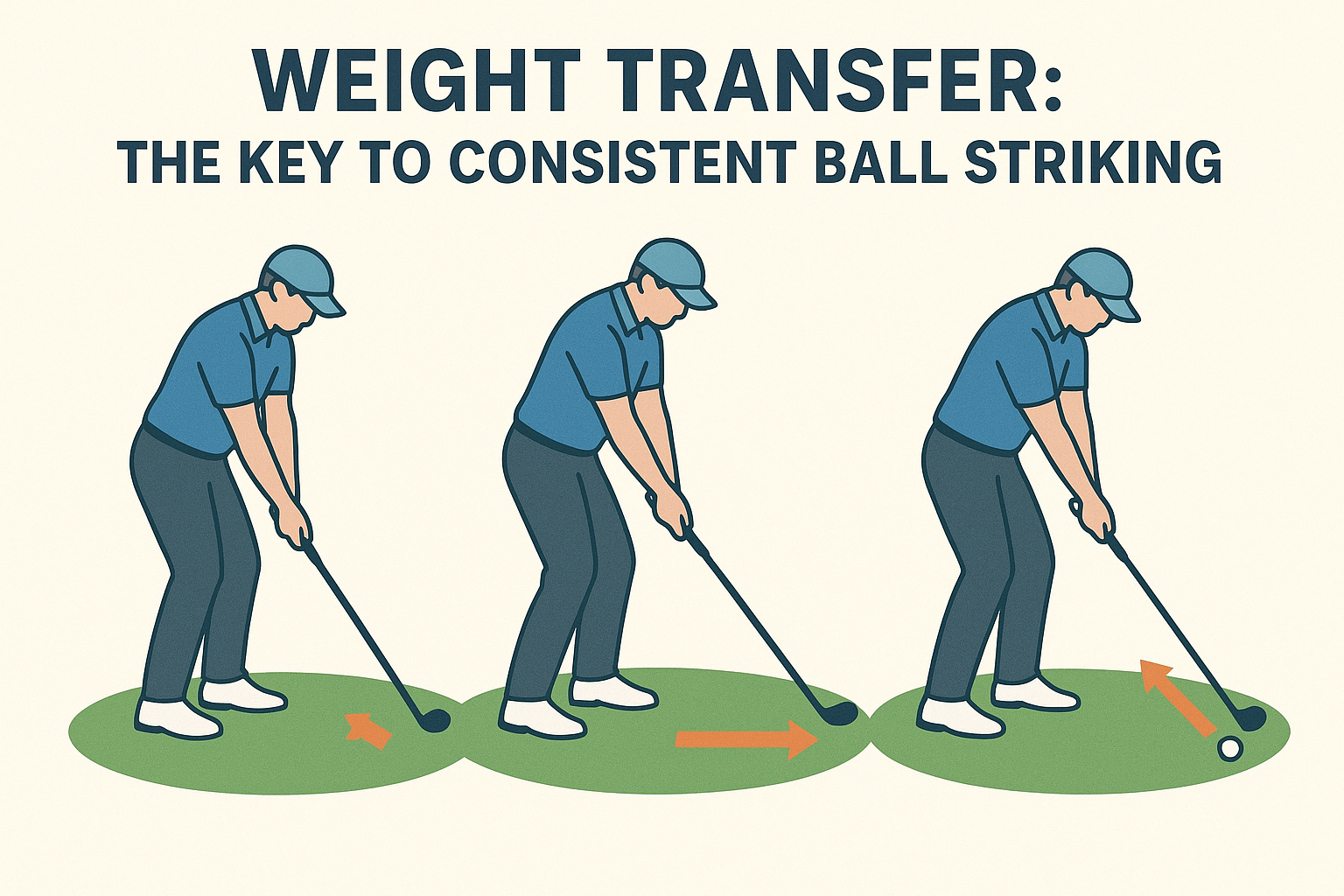
Weight Transfer: The Key to Consistent Ball Striking
Focused Topic: Weight transfer refers to how you move your center of gravity from your trail (back) foot toward your lead (front) foot as you swing. It’s a deliberate, athletic shift that starts in the backswing and continues through impact into the follow‑through. Mastering this single element helps you strike the ball more consistently and with better compression, distance control, and balance.
What the concept is
- During a natural, athletic swing, your weight loads onto the trail foot in the backswing and then moves forward to the lead foot in the downswing and through impact.
- This transfer happens in time with your body rotation: hips turn toward the target first, followed by the torso and arms guiding the club to the ball.
- Good weight transfer keeps your spine angle and balance, so you don’t “hit from behind” or “slide off the ball.”
Why it matters to the golf swing
- Improved contact: landing more weight on the lead side at impact helps you compress the ball and reduce mishits.
- Better balance: finishing with solid balance reduces the chance of thin, fat, or mishit shots.
- Consistent power: transferring weight effectively stores and releases energy through the path of the club.
What you should feel when done correctly
- In the backswing, you feel comfortable pressure on the trail foot and a slight sinking into the right heel (for right-handed players).
- During the transition, you feel the hips starting the move, and your weight begins to shift toward the lead foot.
- At impact, most of your weight is on the lead foot, with a solid, grounded feeling through the ball.
- At finish, you balance on the lead leg with the chest facing the target and the trail foot lightly touching the ground or pointing to the sky—depending on your swing style.
2–3 common mistakes and simple fixes
- Mistake: Stalling weight on the trail foot too long, causing thin or fat shots.
- Fix: Imagine stepping into the shot. In the downswing, feel the weight moving toward the lead foot as your hips rotate first. Cue: “hips first, then arms.”
- Mistake: Excessive lateral sway instead of a controlled weight shift.
- Fix: Keep a narrow, athletic stance and lengthen your spine angle. Cue: “don’t slide—rotate.” Place a wall drill in mind: your head stays near the same vertical line while your hips rotate and your weight shifts forward.
- Mistake: Rushing the transfer, causing early release or loss of balance.
- Fix: Slow the transition. Pause for a brief moment at the top of the backswing, then initiate the downswing with the hips and a deliberate weight shift. Cue: “pause and go.”
One easy practice drill (home or range)
Step-Through Weight Transfer Drill – foot-to-foot progress to ingrain the shift from back foot to lead foot without losing balance.
- Set up as you normally would. Take a half-swing to a comfortable height (not full effort).
- At the top, pause for a 1‑second count. Feel the weight on your trail foot and your hips starting to turn.
- Start the downswing by rotating your hips toward the target, and step forward with your lead foot as you would in a full swing. The trail foot will naturally lift onto its toe as you finish.
- Finish in a balanced position with most weight on the lead foot and your chest facing the target.
- Repeat 8–12 reps, gradually increasing speed as balance and feel improve.
Tip: practice this with a doorway or wall behind you to limit lateral movement. If you’re at the range, use a gentle step-through after impact to reinforce the feeling of transferring weight forward through the ball.
This focused approach stays on weight transfer without getting tangled in a full-swing overhaul. Build the habit, and you’ll notice more solid contact, better ball flight, and steadier rounds.
Weight Transfer: The Key to Consistent Ball Striking
Weight transfer is the foundational mechanic behind reliable ball striking in golf, tennis, baseball, and similar sports. When players shift their weight correctly thru impact, they generate power, control, and accuracy while reducing the risk of swing faults. This thorough guide explores how to understand, train, and apply weight transfer to achieve consistent ball striking across different shots and situations.
Why Weight Transfer Matters in Ball Striking
Weight transfer refers to the deliberate movement of your body’s center of gravity from one set of joints to another during the swing, stroke, or contact phase. The goal is to use the ground as a source of energy, convert it through your kinetic chain, and deliver a clean, stable strike. Key benefits include:
- Increased power without over-swinging: Transferring weight efficiently allows the body to release stored energy through the ball rather then forcing the shot wiht shoulder or arm effort alone.
- Improved contact quality: Proper weight shift helps you meet the ball on the correct part of the clubface or racket string bed, improving trajectory and spin control.
- Enhanced consistency: When the weight movement is repeatable, variations diminish and your ball striking stabilizes across sessions.
- Injury prevention: Distributing load through the legs and hips reduces undue stress on the lower back and shoulders during high-speed swings.
The Mechanics Behind Weight Transfer
Understanding the mechanics helps you translate concept into drills. Consider these core elements:
- Ground reaction force: The force the ground exerts upward, enabling your legs to push into a powerful swing or stroke.
- Sequencing: A well-timed sequence—often starting from the ground up—transfers energy through the hips, torso, and arms to the impact zone.
- Center of gravity shift: The body’s weight moves toward the target side through impact, then settles into a stable finish.
- Rotation and stabilization: Efficient hips and torso rotation unlocks energy while maintaining balance and control.
Practically, think of weight transfer as a controlled choreography: your feet, legs, hips, and torso work in harmony to deliver a consistent strike.
Weight Transfer in Different sports
While the specifics vary, the principle remains the same: getting your weight moving in the right direction at the right time enhances force production and contact quality. Here’s how weight transfer shows up in common ball-striking disciplines:
Golf
In golf, effective weight transfer generally involves a progressive shift from the trail foot toward the lead foot through the down-swing and into impact, followed by a controlled finish.A common cue is to “feel the trail knee flex and then straighten as you rotate through impact.”
Tennis
In tennis, weight transfer is about loading the back leg during the backswing and releasing energy through the forward step and through the shot. A stable knee bend and hip rotation help you drive the ball with control and pace.
Baseball/Softball
Baseball hitters rely on a pronounced weight shift from the back foot toward the front foot as the hips rotate and the hands extend toward the ball. The goal is to make contact while the weight is moving forward, not after it stops.
Cricket
Cricket strokes benefit from a deliberate shift toward the front foot during or just before contact, enabling a compact swing with efficient energy transfer from body to bat.
How to Train Weight Transfer: Drills and cues
Consistent weight transfer requires both awareness and deliberate practice. The following drills and cues help you internalize the sequence across different sports and shots.
General Drills for All Sports
- Stand in a athletic stance, perform a slow backswing or wind-up, then step toward the target as you extend through impact. Focus on the trail-to-lead weight shift.
- Practice with a single leg support for a few seconds on the trail leg, then transition to full swings. This builds leg drive and balance for weight transfer.
- Use a mirror or video to monitor how your hips and shoulders rotate and how your center of gravity shifts during impact.
Sport-Specific Cues
- “Feel the trail knee drive into extension as you rotate through the ball.” This helps you initiate the sequence from the ground up.
- Tennis Cue: “Load on the back foot; transfer weight into the front foot as you strike.” Emphasize forward momentum rather than reaching with the arm.
- Baseball Cue: “Hit with momentum from back heel to front toe; avoid stopping weight at contact.”
Progression Drills by difficulty
- Beginner: Slow-motion swings or strokes with feedback on weight transfer timing. Focus on contact quality first.
- Intermediate: Add a light resistance band or a weighted vest (low intensity) to promote leg drive and hip rotation without sacrificing form.
- Advanced: Integrate speed and accuracy targets, like hitting toward a specific spot or achieving a certain ball trajectory while maintaining proper weight transfer.
Practical Cues for Immediate Improvement
- Foot pressure: Feel pressure shift from the back foot to the front foot starting just before impact.
- Knee dynamics: Let the trail knee flex during the backswing and extend into impact, supporting hip rotation and trunk stability.
- Hip lead: Initiate the movement with hip rotation rather than arm extension. The arms follow as a consequence of the rotation.
- Line of attack: keep a stable spine angle and rotate through the ball along a consistent plane, preventing excessive over-rotation or under-rotation.
- Finish position: End with balanced weight on the lead foot and a controlled, athletic finish so your energy is not wasted in recovery.
Benefits and Practical Tips
Incorporating robust weight transfer into your training offers a range of benefits beyond simply hitting the ball farther.
- Consistency gains: Repeating an efficient transfer sequence reduces variance between shots.
- Shot versatility: Weight transfer helps you shape shots, manage spin, and adjust to different ball positions.
- Fitness integration: Training weight transfer can improve lower-body strength, core stability, and balance without requiring heavy equipment.
- Injury risk reduction: Balanced loading supports joints and reduces peak loads on the spine and shoulders.
case Studies: Real-World Insights
Here are concise, anonymized examples illustrating how weight transfer optimization translates into tangible improvements.
Case Study 1: Golf Player in Transition
A mid-amateur golfer struggled with inconsistent contact and loss of distance. After focusing on a deliberate trail-to-lead weight shift and hip-initiated rotation, he reported more solid contact across par-4s and improved fairway accuracy. The key change was a slower, controlled downswing with a deliberate weight transfer sequence, rather than rushing to a powerful but unbalanced strike.
Case Study 2: Tennis Player Streak Improvement
A competitive junior tennis player noticed fluctuating footwork and shot timing during matches. With coaching, she adopted a cue to “load on the back foot, then drive through the front foot” and added a step-through drill. Within weeks, her forehand stability and pace improved, especially on cross-court rallies.
First-Hand Experience: A Short Narrative
During a recent coaching session, I watched a player transform his ball striking by refining weight transfer. We began with slow-motion swings focusing on knee flexion and hip rotation. Using a simple cue—“drive into the front foot while maintaining spine angle”—he began to notice cleaner contact and a more consistent trajectory. By the third drill block, he was able to reproduce the feel under pressure, which translated into better performance on court and course alike.
Table: Weight Transfer Cues by shot Type
| shot Type | Primary Weight Transfer Cue | Common Fault | Fix |
|---|---|---|---|
| Golf drive | Trail knee drive into extension and rotation through impact | Early forward lean; hands get ahead | Pause for a moment at top, feel load and then release |
| Tennis Forehand | Load on back foot, then transfer forward during contact | Late or incomplete transfer, arms dominate | Step into shot; rotate hips first |
| Baseball Swing | Push weight forward from back foot through contact | Push with arms; no forward weight shift | Engage lower body; maintain balance after contact |
Common Faults and How to Fix Them
- Weight stalls during impact, causing thin or fat shots.
- Fix: Rehearse a deliberate forward press, momentary pause, then release; ensure the trail leg drives energy forward.
- Over-rotation leading to hooks or slices.
- Fix: Maintain a stable spine angle and rotate through impact while keeping the hands soft and connected to the body’s rotation.
- Lunging toward the ball and losing balance.
- Fix: Focus on a solid base; keep weight over the mid-to-front foot and use a controlled step into impact.
Advanced Tips: Integrating Weight Transfer with Your Swing or Stroke
- Exhale through impact to help relax the torso and encourage a clean transfer.
- Record your swings or strokes to verify whether the weight shift occurs as planned and adjust cues accordingly.
- Practice with different stances, ball positions, and speeds to ensure your weight transfer remains reliable in varied contexts.
FAQ: Quick Answers on Weight Transfer and Ball Striking
- What is weight transfer?
- Weight transfer is the deliberate movement of your body’s weight from one side to the other during the swing or stroke, typically from the trail leg toward the lead leg, enabling energy to be stored in the body and released through impact.
- Why is weight transfer importent for consistency?
- Because it creates a repeatable energy pathway from the ground up, helping you strike the ball with the same timing and contact point, nonetheless of shot type or speed.
- How long does it take to see improvements?
- Most players notice improvements within a few weeks of focused practice, though the rate depends on baseline technique, practice consistency, and coaching quality.