
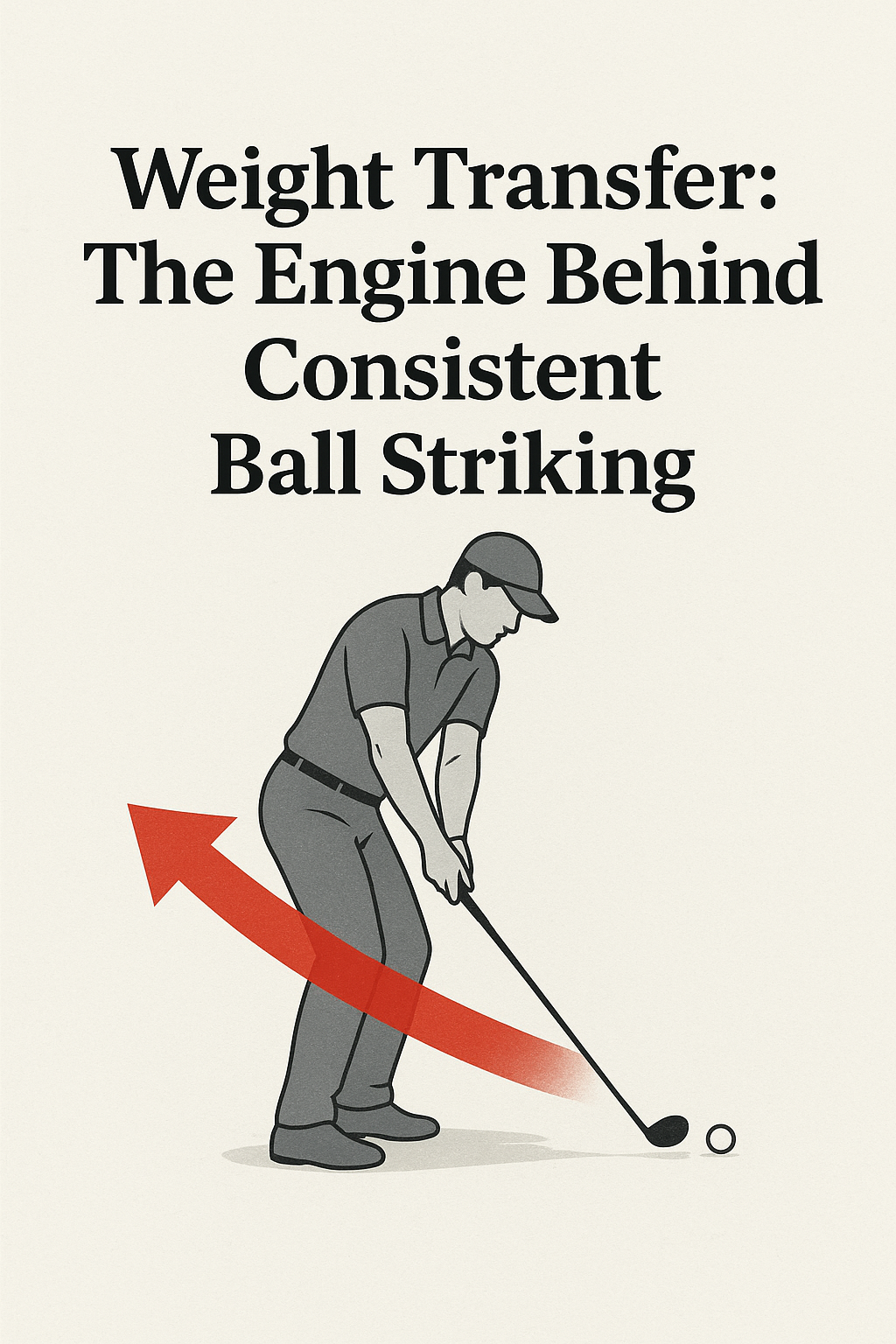
Weight Transfer: The Engine Behind Consistent Ball Striking
Weight transfer is the simple idea of moving your body’s pressure from the trail foot to the lead foot at the right moment during the swing. For most players, getting this timing right is more important than lifting the perfect hands or swinging faster.
What the concept is
In a normal golf swing, you load into the trail leg during the backswing and then transfer that load toward the lead leg through impact. Think of it as a controlled shift of your center of gravity from back to front, not a big lunge or a slide. Proper weight transfer helps you maintain balance, keep the spine angle, and let the arms and club release naturally.
Why it matters to the swing
- Helps compress the ball. When weight moves correctly, the hands release and the clubface returns to the ball at the right moment.
- Improves contact consistency. A balanced base reduces fat and thin shots caused by rushing or collapsing.
- Promotes solid sequencing. A smooth transfer supports the sequence of hips → torso → arms → hands, creating steadier ball flight.
What the golfer should feel when doing it correctly
- In the backswing, you feel the trail foot grounding a bit more; you’re loading, not leaning.
- Transition to downswing begins with the hips rotating and the chest turning toward the target, not a big slide to the left.
- At impact, most of your pressure is moving forward into the lead foot, while the head stays relatively centered over the midline.
- Finish with weight comfortably over the lead foot and the chest facing the target.
2–3 common mistakes and fixes
- Mistake 1: Early weight shift to the lead foot during the downswing, which can cause thin or fat shots.
- Fix: Start the downswing with subtle hip and chest rotation, not a big lunge. Practice with a towel under the lead foot to train staying on the trail foot a split second longer and then transferring smoothly.
- Mistake 2: Not loading the trail foot enough in the backswing, so there’s little-to-no transfer.
- Fix: Feel 60–70% of your weight on the trail foot at the top of the backswing. Use a light club across your shoulders to help feel the turn without swaying.
- Mistake 3: Lateral slide rather than rotation, moving your center of gravity off the target line.
- Fix: Focus on turning the hips and torso around a stable spine. A wall drill can help: stand with your back lightly touching a wall and rotate your hips to about 45 degrees while keeping your butt, shoulder blades, and head close to the wall.
One easy drill you can do at home or at the range
- Feet-together weight transfer drill:
– Stand with your feet touching lightly, holding a short iron or a foam ball against your chest.
– Rotate to the backswing, feeling most of the weight press into the trail foot.
– On the downswing, shift toward the lead foot with a smooth, balanced move and finish with chest facing the target.
– Do 2 sets of 10 half-swings, focusing on a calm, controlled transfer rather than speed.
Tip: keep your head steady and your balance centered as you practice. Weight transfer is a rhythm thing—smooth, not forced. With a little repetition, you’ll notice more solid contact and more consistent ball flight.
Weight Transfer: The Engine Behind Consistent Ball Striking
weight Transfer: The Engine Behind Consistent Ball Striking
Core concept: What weight transfer really means
Weight transfer describes the deliberate shift of a player’s center of gravity from one part of the stance to another during the swing. It’s not merely moving a leg; it’s the synchronized flow of force through the kinetic chain—from ground contact up through the hips, torso, shoulders, and finally the arms and hands to the ball. When executed with proper timing and balance, weight transfer enables maximum energy transfer to the ball, resulting in faster club or paddle speed, cleaner strikes, and more consistent outcomes.
Key idea: the goal is to progressively load energy on the trail side (frequently enough the back foot or rear hip) during the backswing and then release that energy through the lead side (front foot/lead hip) at impact. Proper weight transfer reduces excess vertical or lateral drift, keeps the swing plane intact, and stabilizes the base for precise contact.
Biomechanics of weight transfer: How the body channels energy
- : Energy flows from the ground up through the feet, ankles, knees, hips, core, and upper body. Each link must respond in sequence to maximize impulse at impact.
- center of mass and balance: The body’s center of mass should remain centered over a stable base. A controlled shift toward the lead foot at the right moment helps deliver power without losing balance.
- Ground reaction forces: Ground forces provide the reaction needed to accelerate the body toward the ball. Efficient weight transfer uses these forces rather than relying solely on arm speed.
- Hip rotation and core engagement: Hip and torso rotation store rotational energy. Proper sequencing allows the hips to lead the swing’s initiation, followed by torso and arms for a cohesive strike.
- Spine angle and posture: Maintaining posture through the transfer prevents casting or overextension, aiding control and contact quality.
Across sports, the basic pattern remains consistent: load then unleash.In golf, the trail leg stores energy during the backswing and releases it toward impact. In tennis, weight frequently enough shifts from the trailing foot to the front foot as you drive through the ball. In baseball, weight moves from the back side into the front side during the swing, helping to drive the bat through the hitting zone.
Weight transfer across sport contexts: golf, tennis, and baseball
- Golf: The backswing loads weight on the right/lead side depending on stance; the transition to impact uses the left side to deliver forward shaft lean and solid contact.
- Tennis: In an aggressive groundstroke, players transfer weight from the back foot to the front foot as they rotate through the shot, stabilizing the step and following through with a long extension.
- Baseball/softball: The load happens with weight shifting toward the back leg during the leg kick or stride, followed by a powerful push off the back leg and through to the front side at contact.
While sport-specific cues vary, the core principle—efficiently moving the center of mass in the direction of the shot—stays the same. coaches tailor cues to the sport and individual athlete, but the physics remains universal.
Practical cues to optimize weight transfer
- : Imagine loading a spring on the trailing side and releasing it through the front foot at impact.
- Foot-ground contact cue: Maintain even pressure across the foot before transition; at the moment of impact, feel pressure shift toward the lead foot.
- Hip-shoulder sequencing: Lead with the hips in the swing’s downswing, letting the torso and arms follow in a natural order.
- Posture cue: Keep a slight knee flex and a tall spine to preserve balance during the transfer.
- Lead foot stability: Avoid collapsing the lead knee or sliding out of the forward heel; stable contact supports cleaner transfer.
- Breath and timing: Exhale through impact to relax the torso and maintain a smooth transfer tempo.
Drills and practice routines to build reliable transfer
These drills focus on anchoring the transfer pattern, improving balance, and reinforcing proper sequencing.Do each drill for 2–3 sets of 8–12 reps, then integrate into full-swing practice.
- Step-through transfer drill: From a static stance, take a short backswing and step into a forward position while transferring weight onto the lead foot. Focus on a smooth, controlled transition with minimal lateral movement.
- Wall drill with slight hinge: Stand close to a wall with the trail shoulder/back slightly away. As you initiate the downswing, press into the wall with the trail leg to feel how weight travels to the lead side without losing posture.
- Heel-to-toe weight shift: Shuffle your feet in a controlled manner, focusing on the heel-to-toe transfer during the downswing.Visualize pushing the ground away to drive weight forward.
- Medicine ball rotational throws: Stand tall, rotate hips and torso, and execute a controlled throw. Emphasize a rapid transfer of weight from the trailing foot to the leading foot to accelerate the ball and engage the kinetic chain.
- Impact tape or impact bag feedback: Practice with a light impact bag or impact tape so you can see if weight is properly shifting into the lead side at contact.
| Drill | Purpose | Key feeling |
|---|---|---|
| Step-through transfer | Reinforces weight shift during transition | Lead foot bears most contact at impact |
| Wall drill | Maintains posture while transferring weight | Stable spine; hips initiate movement |
| Heel-to-toe drill | improves balance and transfer timing | Smooth weight move, minimal side-to-side drift |
| Medicine ball throws | Connects hip rotation with arm acceleration | Hips drive the move; torso follows |
Benefits of mastering weight transfer
- Increased consistency: Reproducible contact point and ball flight.
- Improved power: Efficient energy transfer yields higher ball speed without over-relying on arm strength.
- Enhanced control: Better balance reduces off-center hits and mishits.
- Injury prevention: Proper sequencing minimizes undue stress on the lower back and shoulders.
- Sport versatility: The same principles apply across golf, tennis, and baseball, enabling cross-training benefits.
Case study: Real-world impact of intentional weight transfer
A mid-amateur golfer focused on weight transfer cues for 6 weeks. Using a combination of the step-through transfer drill and the Wall drill, the player reported cleaner contact and a noticeable increase in carry distance. Launch monitor data showed modest but consistent gains in ball speed and a narrower dispersion pattern. The coaching notes highlighted improved sequencing: hips initiating the downswing, followed by a connected torso and arms, culminating in a stable lead-side finish. While individual results vary, a structured transfer routine often correlates with more predictable ball flight and reduced swing faults.
First-hand experience: A coach’s perspective
From coaching dozens of players, the simplest truth about weight transfer is this: when athletes learn to load energy on the trail side without dumping it prematurely, they unlock a dependable path to the ball.The moment a player understands that the lead foot’s stability is the anchor for contact, swing speed becomes easier to generate as the body isn’t fighting gravity or balance. In practice, adding one or two targeted cues at a time—such as “hips first, then hands”—often yields immediate gains in both accuracy and distance without overwhelming the learner.
Practical tips at a glance
- Always start from a balanced setup with light,even pressure across both feet.
- During the backswing, feel weight shift toward the trail side; during downswing, aggressively move weight to the lead side through impact.
- Keep the spine angle constant; avoid excessive lateral movement that disrupts the swing plane.
- Use drills consistently in warm-ups and practice sessions to reinforce proper sequencing.
- Record short videos to analyze foot placement, hip rotation, and contact quality from different angles.
Quick-reference comparison: weight transfer cues by sport
| Sport | Primary weight transfer cue | Impact on contact |
|---|---|---|
| golf | Load on trail leg during backswing; press into lead foot at impact | Cleaner strike, solid iron/wood contact, improved distance control |
| Tennis | Shift weight forward through the shot; rotate hips into contact | Faster racket speed and better ball placement |
| Baseball/Softball | Load back, then drive weight through front side | Increased bat speed and consistent contact point |
| Fault | Symptom | Fix / Cue |
|---|---|---|
| Early release | Ball launches high or off-line | Delay release slightly; emphasize hip-then-torso sequencing |
| Heavy head or loss of posture | Missed center of gravity; inconsistent ball flight | Maintain spine angle; practice with wall drill to hold posture |
| Over-rotation without transfer | Poor balance; late impact | Coordinate hip rotation with a steady lead-side push during impact |
Related resources and further reading
- Biomechanics of Swing: Analyzing the Kinetic Chain
- Ground Reaction Forces in Sports: How the Feet Drive Power
- Coaching cues for consistent ball striking across sports